K-Pop Fan Survival Guide: Essential Terminology
Walking into K-Pop fandom for the first time can feel like arriving in a foreign country without a phrasebook. Fans throw around words like "bias," "comeback," and "maknae" as casually as breathing, and if you don't know the lingo, you'll be lost before the first chorus hits. Whether you just discovered your first group through a viral TikTok or you've been casually listening for a while and want to go deeper, this guide will get you up to speed on the terms that every K-Pop fan uses daily.
Group Roles & Positions
Every K-Pop group has an internal structure with assigned positions. These aren't just labels; they shape how each member contributes to the group's music, performances, and public image.
Bias, Bias Wrecker, and Ult Bias
Your bias is your favorite member in a group. This is the person you gravitate toward, the one whose fancams you watch on repeat, whose photocards you collect first. The word comes from the idea that you're "biased" toward them.
A bias wrecker is the member who constantly threatens to dethrone your bias. You've committed to one member, but this other person keeps doing things that make you question your loyalty. It's a running joke in fandom that bias wreckers cause genuine emotional distress.
Your ult bias (ultimate bias) is your number one across all groups. You might have a bias in every group you follow, but your ult is the one above them all.
The Age Hierarchy
Korean culture places significant importance on age, and this carries directly into K-Pop groups. The maknae (막내) is the youngest member of the group. Maknaes often get babied by older members, though some groups have a "evil maknae" who teases the elders instead.
The Korean honorific system also shows up constantly in fan content:
- Hyung (형) — used by males to address an older male
- Oppa (오빠) — used by females to address an older male
- Unnie (언니) — used by females to address an older female
- Noona (누나) — used by males to address an older female
You'll hear these in behind-the-scenes content, variety shows, and V Lives constantly. Understanding who calls whom what tells you a lot about the group's dynamic.
Official Positions
K-Pop groups assign specific roles to each member, and most groups announce these publicly:
- Leader — the member responsible for representing the group, often speaking first in interviews and mediating between members. The leader isn't always the oldest or most talented; it's about responsibility and leadership qualities.
- Main Vocal — the member with the strongest singing ability, typically handling the most difficult vocal parts and high notes.
- Lead Vocal — the second-strongest vocalist, who supports the main vocal and often gets significant singing parts.
- Main Dancer — the best dancer, usually positioned at the center during dance breaks and choreography-heavy sections.
- Main Rapper — the primary rapper, handling the most technically demanding rap verses.
- Visual — the member considered the most conventionally attractive by Korean beauty standards. This is an official position in many groups, which surprises a lot of international fans.
- Center — the member who frequently occupies the center position in formations. Often overlaps with the visual or main dancer.
- Face of the Group — the most publicly recognized member, often appearing in variety shows or dramas to boost the group's visibility.
One member can hold multiple positions. It's common to see someone listed as "main dancer, lead vocal, center" or "leader, main rapper, visual."
Releases & Promotions
The way K-Pop handles music releases is its own ecosystem, and the terminology reflects that.
Comeback and Debut
A comeback doesn't mean a group went away. In K-Pop, every new release cycle is called a comeback, even if the group was promoting something else just two months ago. A comeback includes the new music, a concept (visual theme), music video, choreography, and a promotional period on music shows.
A debut (데뷔) is a group's very first release. Debut dates are treated almost like birthdays in fandom, and anniversary celebrations are a big deal.
Release Types
K-Pop has several distinct release formats:
- Mini album (EP) — typically 4-7 tracks. The most common release format in K-Pop.
- Full album — 10+ tracks. Considered a major milestone, especially for newer groups.
- Repackage — a re-release of a previous album with added bonus tracks and sometimes a new title track. Fans have mixed feelings about these since they often need to buy a near-duplicate album.
- Special album — a release outside the normal comeback cycle, often tied to holidays or anniversaries.
- Pre-release — a single dropped before the main album to build anticipation.
- Title track — the primary promoted song from an album, the one performed on music shows.
- B-side — every other track on the album that isn't the title track. Some B-sides become fan favorites that rival the title track in popularity.
Music Shows and Wins
During a comeback, groups perform their title track on weekly music shows. The major ones include:
- M Countdown (Mnet, Thursdays)
- Music Bank (KBS, Fridays)
- Show! Music Core (MBC, Saturdays)
- Inkigayo (SBS, Sundays)
Each show has its own scoring system based on a combination of digital sales, physical sales, voting, and broadcast points. Winning first place (a win) is a significant achievement, and you'll often see emotional acceptance speeches, especially from rookie groups getting their first win.
Groups promote on these shows for about 2-3 weeks per comeback. The promotional period is intense: daily schedules, fansigns, variety show appearances, radio interviews, and content filming, all packed into a short window.
Fan Culture
K-Pop fandom is arguably the most organized and dedicated fan culture in the world. Here's the vocabulary you need to navigate it.
Lightsticks and Fan Chants
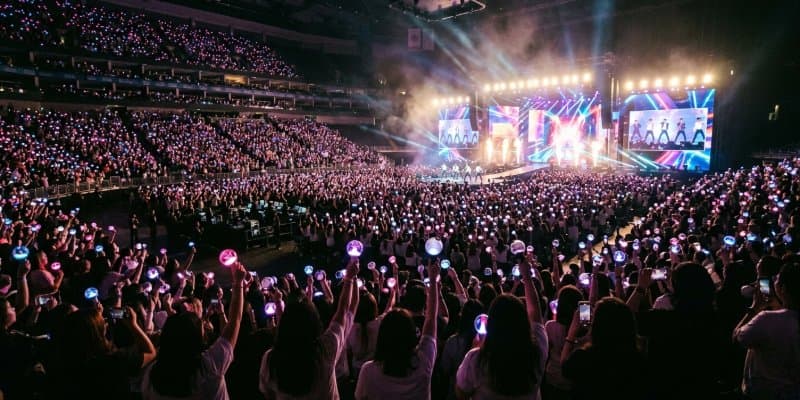
A lightstick is an official LED device sold by each group, designed with a unique shape that represents the group. ARMY bombs (BTS), Candy Bongs (TWICE), and Keyring Lightsticks are some famous examples. At concerts, thousands of lightsticks synced via Bluetooth create stunning oceans of coordinated color.
Fan chants (응원법) are choreographed audience responses during specific parts of a song. They're not random screaming; they follow a precise script, usually calling out member names during instrumental breaks or echoing specific lyrics. Learning the fan chant before attending a concert is practically mandatory.
Every major group also has an official fandom name. ARMY (BTS), BLINK (BLACKPINK), ONCE (TWICE), STAY (Stray Kids), MY (aespa). These names often carry deeper meaning connecting the fans to the group.
Photocards and Collecting
Photocards are small, trading-card-sized photos of members included in physical albums. Each album version comes with random photocards, which has spawned an enormous trading and collecting culture. Rare photocards from limited editions can sell for surprisingly high prices on the secondhand market.
Speaking of which, album versions are a core part of K-Pop's physical sales strategy. A single album release might come in 4-8 different versions, each with different cover art, photobook content, and photocard sets. Dedicated fans often buy multiple versions to collect all the photocards, which is exactly why K-Pop physical sales numbers are so massive.
Streaming and Charting
K-Pop fans don't just listen to music casually; they stream strategically. Organized streaming parties aim to boost a song's numbers on platforms like Spotify, Apple Music, and Korean platforms like Melon and Genie. Fans coordinate time zones, create streaming guides, and track real-time chart positions.
First-week sales (the number of albums sold in the first week after release) have become a major metric for measuring a group's popularity. Breaking first-week records is a point of enormous pride for fandoms.
Charting refers to a song's position on music charts. "All-kill" means a song reached #1 on all major Korean music charts simultaneously, which is extremely difficult to achieve.
What NOT to Do: Sasaeng Culture
A sasaeng (사생, short for 사생활 meaning "private life") is an obsessive fan who invades artists' privacy. This includes following them to private locations, obtaining their phone numbers, showing up at their homes, or booking the same flights. Sasaeng behavior is universally condemned by healthy fan communities and is, in many cases, illegal.
Respecting boundaries is fundamental. Supporting an artist means celebrating their public work, not intruding on their personal space. The K-Pop industry has increasingly taken legal action against sasaeng behavior, and fandoms actively work to report and discourage it.
Common Korean Terms You'll Hear Everywhere
Beyond K-Pop-specific vocabulary, certain Korean words have become part of the global fan lexicon:
- Aegyo (애교) — acting cute, often exaggerated with baby voices, pouty faces, and heart gestures. Some idols are known for their natural aegyo, while others hilariously resist doing it on variety shows.
- Selca (셀카) — a selfie. Short for "self camera" (셀프 카메라). Idols post selcas on social media constantly, and fans lose their minds every time.
- Mukbang (먹방) — an eating broadcast. Many idols do mukbang content where they eat large amounts of food on camera. It's wildly popular and surprisingly entertaining.
- Fighting / Hwaiting (화이팅) — a cheer of encouragement, like "You can do it!" or "Let's go!" You'll hear this at concerts, in fan messages, and basically anywhere Korean enthusiasm exists.
- Daebak (대박) — an exclamation meaning "amazing," "wow," or "jackpot." Used when something incredible happens, like your bias posting a selca right when you were thinking about them.
- Kkul-jaem (꿀잼) — literally "honey fun," meaning something is extremely entertaining.
- Nae-seupo (내스포) — self-spoiler, when an idol accidentally reveals upcoming plans or spoilers about new music.
Putting It All Together
Now that you've got the vocabulary down, you'll find that K-Pop content suddenly makes a lot more sense. Those YouTube comments arguing about who the best main vocal of the 4th generation is? You get it now. That tweet celebrating a group's first music show win with their latest comeback? Completely understandable.
The terminology keeps evolving as fandom culture grows and new trends emerge, but the core vocabulary covered here will carry you through most conversations and content. The best way to solidify your knowledge is to engage: watch variety shows with subtitles, follow fan accounts, read album reviews, and most importantly, listen to the music.
Think you already know your K-Pop groups well enough? Put your knowledge to the test with our K-Pop Boygroup Quiz or K-Pop Girlgroup Quiz and see how you really stack up against other fans worldwide.