Korean Food Culture: More Than Just Kimchi
Korean food has taken over the world. From kimchi showing up in grocery stores across five continents to Korean BBQ restaurants becoming a staple in every major city, the global appetite for Korean cuisine has never been stronger. But here's the thing: the food itself is only half the story. Korean dining is wrapped in centuries of social customs, unwritten rules, and cultural significance that most people outside Korea never learn about. Understanding these traditions transforms a meal from just eating into a genuine cultural experience.
Rice Is Life
In Korean, one of the most common greetings is "밥 먹었어?" (bap meogeosseo?) which literally translates to "Have you eaten rice?" It's not really a question about your meal schedule. It's a way of asking "How are you? Are you doing okay?" The fact that eating rice became synonymous with general well-being tells you everything about how central rice is to Korean culture.
Rice (밥, bap) appears at virtually every Korean meal. It's not a side dish or an afterthought; it's the foundation that everything else revolves around. A traditional Korean meal is structured as bap (rice) and banchan (side dishes), with the rice acting as the neutral base that balances all the bold, fermented, spicy, and savory flavors surrounding it.
Leaving rice in your bowl at the end of a meal was traditionally considered wasteful and disrespectful, a reflection of Korea's history with food scarcity. While younger generations are more relaxed about this, the cultural weight of rice remains strong.
Banchan: The Art of Sharing
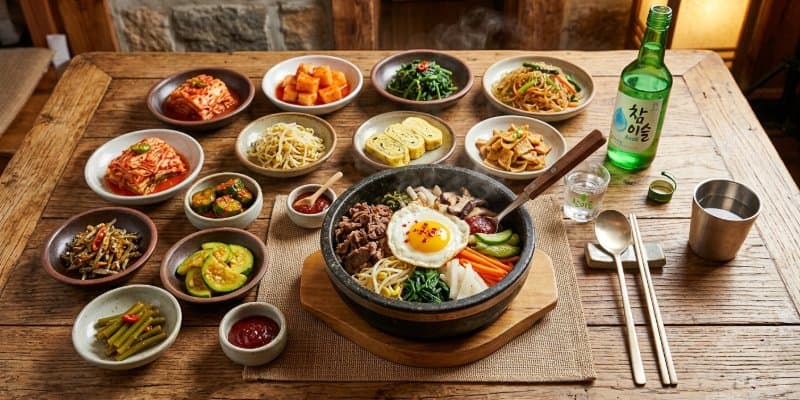
Banchan (반찬, side dishes) are the small plates that arrive at your table before (or alongside) your main dish. And they keep coming. At a typical Korean restaurant, you might receive anywhere from 3 to 12 different banchan, all included with your meal at no extra charge. Refills are free too. Just ask.
First-time visitors to Korean restaurants are often stunned when a dozen small plates suddenly appear on their table without being ordered. This isn't an upselling tactic. It's just how Korean dining works.
Common banchan include kimchi (of course), kongnamul (콩나물, seasoned bean sprouts), sigeumchi namul (시금치나물, spinach), japchae (잡채, glass noodles), and gyeran-mari (계란말이, rolled egg). The selection varies by restaurant and season.
The key cultural element here is sharing. Banchan are communal. Everyone eats from the same plates. This reflects a deeper Korean value: meals are a collective experience, not an individual one. You don't order "your" banchan; the table shares everything. Reaching across the table, eating at different paces, and occasionally nudging a good piece of kimchi toward someone else are all part of the rhythm.
Soju Etiquette: Rules You Actually Need to Know
Soju (소주) is Korea's national spirit, a clear liquor typically around 16-20% alcohol. Koreans consumed roughly 4 billion bottles of soju in recent years, making it one of the best-selling spirits on Earth. But soju isn't just a drink; it comes with a set of social rules that Koreans take seriously.
Pouring for others: You never pour your own drink in a group setting. You pour for others, and they pour for you. If someone's glass is empty, it's polite to offer a refill. Use two hands when pouring for someone older or more senior: one hand on the bottle, and the other hand supporting your pouring arm at the wrist or forearm. This two-handed gesture is a sign of respect that applies beyond drinking. You'll see it when Koreans receive business cards, gifts, or anything handed to them by someone senior.
Receiving a drink: When someone older pours for you, hold your glass with both hands. This mirrors the respect shown in pouring.
Turning away: When drinking in the presence of someone older or higher-ranking, it's customary to turn your head slightly to the side. Drinking while directly facing an elder is considered impolite. This one surprises most foreigners, but Koreans notice when you do it, and they definitely notice when you don't.
The first shot: The first round of soju is often drunk together as a group. Someone will say "건배!" (geonbae, cheers) or "위하여!" (wihayeo, "to us!"), and everyone drinks at the same time.
Mixing drinks: "Somaek" (소맥) is a popular combination of soju and beer (맥주, maekju). The ratio is hotly debated, but roughly 3 parts beer to 1 part soju is common. Some people get creative with the mixing technique, using chopsticks to stir or tapping the glass in specific ways.
Korean BBQ: The Communal Table
Korean BBQ (고기구이, gogigui) might be the most social dining experience on the planet. A grill sits at the center of the table, and everyone cooks and eats together. There's no individual plate of pre-cooked food. You're actively participating in preparing the meal as a group.
The standard Korean BBQ experience goes like this: raw meat arrives at the table (samgyeopsal (삼겹살, pork belly) and galbi (갈비, marinated short ribs) are the most popular), someone takes charge of the grill (there's always one self-appointed grill master in the group), and pieces are cooked, cut with scissors right on the grill, and distributed.
The classic way to eat it is as a ssam (쌈, wrap): take a piece of lettuce or perilla leaf, add a piece of meat, a dab of ssamjang (쌈장, a thick, savory paste), maybe some garlic and peppers, and eat the whole bundle in one bite. Attempting to eat a ssam in two bites is technically possible but generally frowned upon. Go big or go home.
The restaurant staff at many BBQ places will actively manage your grill, adjusting heat, flipping meat, and cutting pieces. This level of service is normal and not something you need to tip for (tipping isn't customary in Korea at all).
Kimchi: A National Identity
Kimchi (김치) deserves its own section because it's not merely a food item in Korea. It's a cultural symbol. There are over 200 varieties of kimchi, though the napa cabbage version (배추김치, baechu-kimchi) is the most recognized internationally.
Kimjang (김장) is the traditional practice of making large quantities of kimchi in late autumn to last through winter. It's a communal event where families, neighbors, and communities gather to prepare hundreds of heads of cabbage together. UNESCO recognized kimjang as an Intangible Cultural Heritage of Humanity in 2013, specifically because of its role in strengthening social bonds.
Many Korean households have a dedicated kimchi refrigerator (김치냉장고), a specially designed appliance that maintains optimal fermentation temperatures. These aren't small. They're often the same size as a regular refrigerator, and many homes have both. The kimchi fridge market is a multi-billion-won industry in Korea.
Kimchi appears at breakfast, lunch, and dinner. It's fried into kimchi-jjigae (김치찌개, kimchi stew), stuffed into kimchi-jeon (김치전, kimchi pancakes), layered into kimchi-bokkeumbap (김치볶음밥, kimchi fried rice), and eaten straight out of the container as a snack. When Koreans travel abroad, kimchi is often what they miss most.
Street Food: The Soul of Korean Snacking
Korean street food, broadly categorized as bunsik (분식, flour-based snacks), is an essential part of daily food culture. Every city and town has street food vendors and small bunsik restaurants where students and office workers grab quick, affordable bites.
The essentials:
- Tteokbokki (떡볶이) — chewy rice cakes in a sweet-spicy gochujang sauce. Arguably the most iconic Korean street food. Ranges from mildly sweet to weapons-grade spicy depending on the vendor.
- Sundae (순대) — Korean blood sausage stuffed with glass noodles, vegetables, and pork blood. Don't let the description scare you; it's a beloved comfort food. Pronounced "soon-dae," not like the ice cream.
- Hotteok (호떡) — a sweet, filled pancake with brown sugar, cinnamon, and chopped nuts inside. Best eaten in winter from a street vendor, burning your fingers and tongue simultaneously.
- Eomuk (어묵) / Odeng (오뎅) — fish cake skewers served in a warm broth. The broth is usually self-serve and free, and on cold days, there's nothing better.
- Gimbap (김밥) — seaweed rice rolls filled with vegetables, pickled radish, and various proteins. Often compared to sushi, but the flavor profile and intent are completely different. Gimbap is grab-and-go fuel, not fine dining.
- Twigim (튀김) — assorted deep-fried items including sweet potato, shrimp, vegetables, and boiled eggs. Korea's answer to tempura, though Koreans would argue it came first.
Delivery Culture: Korea's Superpower
Korea's delivery culture (배달문화, baedal-munhwa) operates on a level that most countries can't comprehend. Through apps like Baedal Minjok (배달의민족, affectionately called "Baemin") and Coupang Eats, you can get virtually any food delivered to virtually any location, often within 30 minutes.
The scope goes beyond what international food delivery apps offer. Koreans order delivery to parks, riverbanks, hiking trail entrances, and even specific benches in public areas. The delivery rider will find you. Some restaurants send their food in real ceramic dishes and metal utensils, which the rider picks up later. During peak times like the World Cup or major K-drama finales, delivery volumes spike so dramatically that it makes national news.
Jjajangmyeon (짜장면, black bean noodles) holds a special place in delivery culture. It's the original delivery food, long predating app-based ordering. Chinese-Korean restaurants have been delivering jjajangmyeon by motorcycle since the 1960s, and it remains one of the most-ordered delivery items today.
Spicy Food: A National Obsession
Korean cuisine is famous for its heat, but the relationship Koreans have with spicy food goes deeper than just tolerance. There's a genuine cultural distinction between people who handle spice well and those who don't.
A 매운맛 마니아 (maewunmat mania, spicy food enthusiast) wears their spice tolerance as a badge of honor. Conversely, being a 맵찔이 (maepjjiri, someone who can't handle spice) is a lighthearted label that friends will tease you about endlessly. TV shows regularly feature spicy food challenges, and restaurants advertise escalating spice levels that go far beyond what most international visitors would consider reasonable.
The base of Korean spice comes from gochugaru (고춧가루, red pepper flakes) and gochujang (고추장, fermented red pepper paste). These provide a warmth that builds rather than an immediate sharp burn. The fermentation element adds a depth of flavor that pure capsaicin heat doesn't have.
If you're sensitive to spice, learn this phrase: "안 맵게 해주세요" (an maepge haejuseyo), which means "Please make it not spicy." Most restaurants will accommodate. No judgment.
Dining Etiquette Foreigners Often Get Wrong
A few practical rules that will save you from awkward moments:
Chopstick rules: Never stick your chopsticks upright in a bowl of rice. This resembles incense sticks used in memorial rites for the deceased and is considered extremely bad luck. Lay them flat across your bowl or on the chopstick rest.
Waiting for elders: Don't start eating before the oldest person at the table picks up their utensils. This is a sign of respect that Korean families observe consistently.
Paying the bill: In Korean dining culture, the concept of splitting the bill evenly (Dutch pay, or "더치페이") exists but isn't the default. More commonly, one person pays for the whole meal, and it's often the oldest person or the one who initiated the gathering. Among friends, people take turns treating each other across multiple outings. If you insist on splitting, that's fine, but offering to pay for the whole table is a gesture that Koreans respect.
Using both hands: When receiving food, drinks, or anything from someone older, use both hands or support your receiving arm. This applies to paying at the counter too.
Soup and rice placement: Rice goes on the left, soup on the right. This arrangement is traditional and still followed at home and in traditional restaurants.
Seasonal and Special Occasion Foods
Korean food culture is deeply tied to the calendar. Certain foods belong to certain moments:
- Tteokguk (떡국, rice cake soup) — eaten on Seollal (설날, Lunar New Year). Eating it symbolizes gaining one more year of age.
- Samgyetang (삼계탕, ginseng chicken soup) — eaten on the hottest days of summer (복날, boknal). The logic of fighting heat with hot soup is counterintuitive to foreigners but deeply rooted in Korean traditional medicine.
- Patbingsu (팥빙수, shaved ice with red bean) — the quintessential summer dessert. Modern versions pile on fruit, ice cream, mochi, and cereal, but the traditional red bean version is still the gold standard for purists.
- Songpyeon (송편, stuffed rice cakes) — made during Chuseok (추석, Korean Thanksgiving). Families make them together, and there's a saying that the person who shapes the prettiest songpyeon will find a beautiful spouse.
A Culture Built Around the Table
Korean food culture isn't something you study from a textbook. It's something you experience at a crowded BBQ joint where smoke fills the air and someone keeps refilling your soju glass. It's in the banchan that magically appear and disappear. It's in the delivery rider who finds you sitting by the Han River at 11 PM with your jjajangmyeon.
The food is incredible on its own, but the customs, the etiquette, and the social rituals are what make Korean dining something truly distinct. Next time you sit down at a Korean restaurant, you'll know not just what to order but how to eat it the way Koreans do.