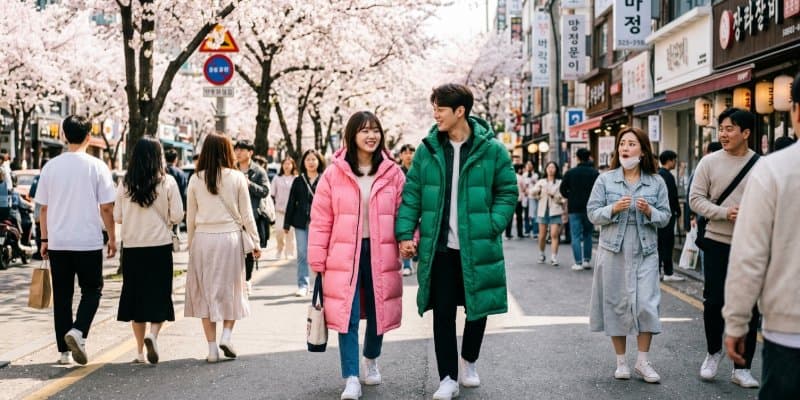
Why Koreans Wear Padding in Warm Weather: Korean Fashion Decoded
If you've ever walked around Seoul in April and spotted someone in a full-length puffer jacket while you're sweating in a T-shirt, welcome to Korean fashion. It operates on a different set of rules, and those rules are deeply tied to Korean culture, social norms, and a sense of aesthetics that doesn't always translate across borders.
Korean fashion surprises visitors constantly. Matching couple outfits on every street corner. School uniforms tailored tighter than business suits. Seasonal wardrobe switches that happen on specific calendar dates regardless of actual weather. And everywhere, the unmistakable influence of K-Pop idols and K-Drama stars dictating what's cool this month.
Here's your guide to understanding why Korean fashion works the way it does.
The Padding (패딩) Phenomenon
"Padding" (패딩, paeding) is the Korean word for puffer jackets, and it's not just a piece of clothing. It's a cultural event.
Every winter, Korea enters what can only be described as padding season. From roughly November through March, the streets transform into a sea of puffy, oversized down jackets. Not thin, lightweight puffers. Full-volume, knee-length, sleeping-bag-level padding that makes everyone look twice their actual size.
The brand matters enormously. For years, owning a North Face or Moncler padding jacket was a status symbol among Korean teenagers and young adults. The pressure was intense enough that the term "등골 브레이커" (deunggol breaker, "spine breaker") entered the language, referring to expensive padding jackets that "break the backs" of parents who have to buy them.
But here's the part that confuses visitors: padding doesn't disappear when the temperature rises. Koreans often keep wearing their puffer jackets well into spring, and some pull them back out in early fall. You'll see people in padding when it's 15°C (59°F) outside, a temperature that most Westerners would consider perfectly comfortable in a light jacket.
Why? A few reasons converge:
- Temperature perception is cultural. Koreans generally bundle up more than Westerners at the same temperature. Air conditioning in summer is set warmer than Western standards, and heating in winter is cranked up higher. The comfort zone is calibrated differently.
- Health beliefs. Traditional Korean thinking links cold exposure to illness more strongly than Western medicine does. Keeping the body warm, especially the core and the stomach, is considered preventive health care.
- Calendar-based dressing. Many Koreans dress according to the season on the calendar rather than the thermometer. If it's technically still winter by date, the padding stays on.
First-time visitors to Korea in late March often pack spring clothes and end up shivering next to Koreans who are still bundled in their winter padding. Check what locals are wearing, not what the weather app says.
Couple Outfits (커플룩) — Love on Display
In most Western countries, wearing matching outfits with your partner would get you strange looks. In Korea, it's romantic.
Couple outfits (커플룩, keopeul-luk) range from subtle to unmissable. On the subtle end, a couple might wear the same color palette or matching sneakers. On the bold end, they'll wear identical outfits head to toe: same jacket, same jeans, same shoes, same hat. Some couples even coordinate their phone cases.
This practice connects to how relationships are viewed in Korean culture. Romantic partnerships are more publicly celebrated and more communally recognized than in many Western societies. Wearing matching clothes signals commitment and unity. It tells the world, "We're together, and we're proud of it."
Couple items (커플템, keopeul-tem) are a massive retail category in Korea:
- Couple rings are exchanged much earlier in relationships than engagement rings in Western culture, sometimes within the first few months of dating.
- Matching pajamas are a popular gift, especially around holidays.
- Couple shoes from brands like Nike or Converse are deliberately purchased in his-and-hers pairs.
Walk through any popular date spot in Seoul on a weekend, and you'll lose count of the matching couples within the first ten minutes.
School Uniform Culture and the Art of Modification
Korean school uniforms (교복, gyobok) are a world of their own. The standard setup is a blazer, dress shirt, tie, and slacks or skirt, looking closer to a prep school outfit than the casual dress codes found in many other countries.
But here's where it gets interesting: students modify their uniforms relentlessly. Skirts get hemmed shorter. Pants get tapered tighter. Blazers get taken in at the waist. The goal is to make the boxy, standard-issue uniform look as flattering as possible, and Korean students have turned this into an art form.
The modification culture is so widespread that many schools have periodic "uniform checks" where teachers measure skirt lengths and pant widths. Students simply re-alter their uniforms afterward.
Beyond daily school wear, uniforms have also become a fashion and nostalgia item. Rental shops near popular tourist areas like Gyeongbokgung and Hongdae offer school uniform rentals so adults can dress up and take photos, reliving their student days. It's a hugely popular activity for friend groups and couples alike.
K-Pop and K-Drama: The Fashion Trendsetters
No conversation about Korean fashion is complete without acknowledging the massive influence of the entertainment industry. K-Pop idols and K-Drama actors don't just reflect trends. They create them.
When a K-Drama character wears a specific coat, that coat sells out nationwide within days. When a K-Pop idol is photographed at the airport in a particular brand, that brand's Korean sales spike immediately. The pipeline from screen to street is remarkably short.
Airport fashion (공항패션, gonghang paesyeon) is a category that exists almost exclusively because of K-Pop. Idols traveling through Incheon Airport know they'll be photographed by fans and media, so they treat the airport terminal as a runway. The outfits are carefully curated, and fashion magazines publish dedicated "airport fashion" roundups.
Some notable examples of entertainment-driven fashion trends:
- Oversized blazers and wide-leg pants surged after multiple K-Drama leads wore them in office settings.
- Crop tops for men gained acceptance in Korea largely because male K-Pop idols wore them on stage, a trend that still raises eyebrows in most Western countries.
- Hair accessories like claw clips and ribbons cycle in and out of popularity based on what female idols wear in music videos and variety shows.
- Bucket hats experienced a massive revival driven by idol off-duty style.
The influence flows both ways. Korean fashion brands actively court idol endorsements, and stylists for major K-Pop groups are considered some of the most influential figures in Korean fashion.
Seasonal Fashion Rules That Confuse Foreigners
Korean fashion follows seasonal transitions with surprising rigidity, and the rules aren't always intuitive to outsiders.
The white rule. While the Western "no white after Labor Day" guideline has mostly faded, Korea has its own version of seasonal color coding. Light, bright colors are associated with spring and summer. Darker, muted tones dominate fall and winter wardrobes. Wearing a bright yellow sweater in December will get you puzzled looks.
The sandals cutoff. Open-toed shoes and sandals appear and disappear within a fairly strict window. Even during a warm spell in late September, many Koreans will have already switched to closed-toe shoes because fall has officially begun.
The coat hierarchy. Outerwear follows a seasonal progression: trench coats in spring and fall, light jackets in early summer and early fall, and padding from November onward. Wearing a trench coat in padding season can read as either fashionably bold or simply underdressed, depending on who's judging.
Layering in summer. Visitors are often surprised to see Koreans wearing long sleeves, cardigans, or light jackets indoors during summer. The reason is aggressive air conditioning. Korean offices, subway cars, and shopping malls can be genuinely cold in summer, and locals come prepared with layers.
Korean Beauty Standards and Their Impact on Fashion
Fashion and beauty are deeply intertwined in Korea, and the prevailing beauty standards shape clothing choices in specific ways.
Skin coverage. Despite the global perception of K-Pop as revealing, everyday Korean fashion tends to be more conservative than what visitors expect. Showing shoulders or cleavage is less common in daily wear than in Western countries. Legs, however, are a different story: short skirts and shorts are widely worn even in relatively conservative settings. The cultural line between "too revealing" and "perfectly fine" is drawn in different places than in the West.
Slim silhouettes. Korean fashion heavily favors slim, tailored fits. While the global trend has moved toward relaxed and oversized styles, Korean fashion tends to maintain a structured, body-conscious approach. Clothing sizes in Korean stores run noticeably smaller than Western equivalents, which can be a frustrating discovery for international visitors shopping in Myeongdong or Gangnam.
Sun protection as fashion. UV protection is taken very seriously, and it shows in fashion choices. Wide-brimmed hats, UV-blocking arm sleeves, sun visors, and even full face-covering sun masks are common summer accessories. Golf-style sun visors that shield the entire face have become a mainstream fashion item, not just athletic gear. This connects to the cultural emphasis on pale, even-toned skin as a beauty ideal.
Matching and coordination. There's a stronger emphasis on head-to-toe coordination in Korean fashion compared to the more eclectic, mix-and-match approach common in Western street style. Accessories, bags, and shoes are expected to complement the overall outfit rather than contrast with it.
Street Fashion Districts: Where the Style Lives
Seoul's fashion identity shifts dramatically from neighborhood to neighborhood. Each district has its own vibe, price point, and crowd.
Hongdae (홍대) is the epicenter of youthful, creative fashion. Named after Hongik University and its renowned art program, the area attracts students, indie musicians, and young creatives. The style here is experimental, colorful, and affordable. Vintage shops, independent Korean designers, and trendy budget brands line the streets. If you want to see what Korean twenty-somethings are actually wearing right now, Hongdae is where you go.
Gangnam (강남) skews polished and expensive. The fashion here leans toward luxury brands, clean lines, and a put-together aesthetic. Designer flagship stores and premium Korean brands dominate the shopping landscape. The Gangnam look is aspirational: sleek, well-groomed, and unmistakably high-end.
Myeongdong (명동) is the tourist and K-Beauty shopping hub. While it's more focused on cosmetics and skincare than clothing, the area offers a concentrated dose of mainstream Korean fashion at accessible price points. It's also where you'll find the most international fast-fashion brands alongside Korean labels.
Itaewon (이태원) and the adjacent Hannam-dong area offer the most diverse fashion scene, blending Korean style with international influences. Boutiques here stock both Korean and global independent designers, and the street style reflects a more globally aware aesthetic.
Seongsu-dong (성수동), often called the Brooklyn of Seoul, has emerged as the newest fashion hotspot. Former factories and warehouses have been converted into concept stores, pop-up shops, and trendy cafes. The fashion here is understated, design-forward, and appeals to a slightly older, more design-conscious crowd.
How Korean Fashion Differs from Western Norms
Beyond specific trends, several fundamental differences separate Korean and Western approaches to fashion.
Conformity vs. individuality. Western fashion culture, especially in the US and UK, celebrates standing out. Korean fashion culture places more value on fitting in while still looking good. The goal is often to execute the current trend better than everyone else, rather than to reject the trend entirely. This creates a fascinating visual effect: Korean streets can look remarkably coordinated, with dozens of people wearing variations of the same trending silhouette.
Age-appropriateness is stricter. Korean fashion has stronger expectations about what's appropriate for different age groups. The bold, trendy looks that dominate in Hongdae thin out dramatically in more corporate districts. Older Koreans maintain a polished, conservative wardrobe that younger Koreans wouldn't touch, and vice versa.
Gender norms are shifting but distinct. Korean men invest significantly more in fashion and grooming than their Western counterparts on average. Male skincare, styled hair, and coordinated outfits are standard, not exceptional. At the same time, some Western gender-neutral fashion trends have been slower to gain traction in mainstream Korean fashion.
Speed of trend cycles. Korean fashion trends move fast. What's popular this month might feel outdated in three months. The combination of social media, K-Pop comebacks, and K-Drama releases creates a trend cycle that spins faster than in most Western markets. Korean consumers are highly responsive to new trends, and fast-fashion brands in Korea release new collections at a pace that keeps up with this demand.
Dressing Korean: The Takeaway
Korean fashion isn't just about clothes. It's a reflection of social values, cultural priorities, and a collective aesthetic sensibility that has been shaped by centuries of Confucian influence, decades of rapid modernization, and the global explosion of Korean pop culture.
The padding stays on because warmth is a cultural value. Couples match because love is meant to be visible. Trends move fast because Korean culture prizes staying current. And the whole system runs on a foundation of nunchi: reading what everyone else is wearing and calibrating your own choices accordingly.
For visitors, the best approach is to observe first and judge later. What looks strange from the outside usually makes perfect sense once you understand the cultural logic behind it. And if you find yourself reaching for a puffer jacket on a mild spring day, congratulations. You're starting to dress Korean.