15 Korean Street Foods You Must Try (and How to Order)
Korean street food isn't a side attraction. It's a core part of daily life. Students grab tteokbokki after school. Office workers inhale gimbap at their desks. Couples share hotteok on winter dates. Street food vendors have been feeding Korea for generations, and the variety, flavor, and affordability are hard to beat anywhere in the world.
Whether you're planning a trip to Korea or just want to know what all those delicious-looking foods on your social media feed actually are, here are 15 street foods you absolutely need to try.
1. Tteokbokki (떡볶이) — Spicy Rice Cakes
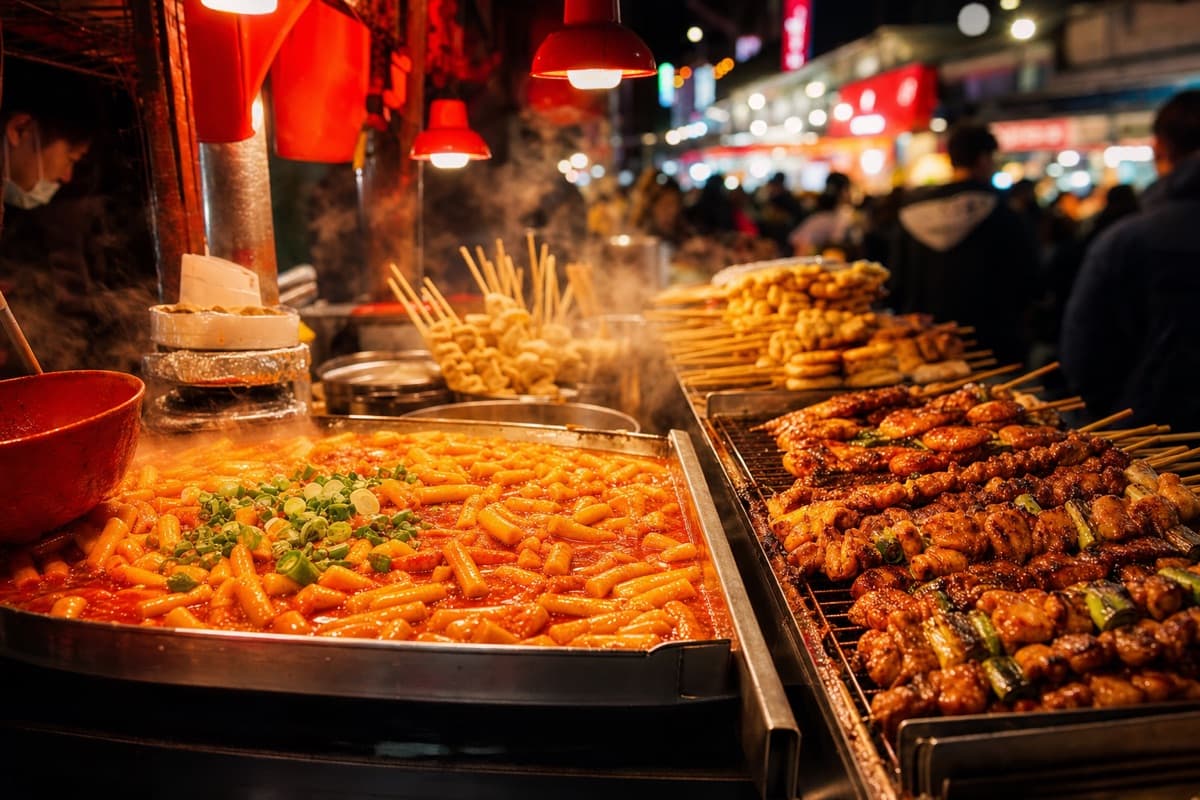
The undisputed champion of Korean street food. Chewy cylindrical rice cakes simmered in a sweet-spicy gochujang (red pepper paste) sauce. The texture is unlike anything in Western cuisine: soft, bouncy, and slightly sticky. Most vendors sell it with fish cakes and boiled eggs mixed in, and the best versions have a sauce that's been developing flavor all day.
- Where: Literally everywhere. Every street food stall, every bunsik restaurant, every pojangmacha (street tent bar).
- Price: Around 3,000-5,000 won (~$2-4)
- Spice warning: Ranges from mild to genuinely painful. Ask "덜 맵게 해주세요" (deol maepge haejuseyo, "less spicy please") if you're cautious.
2. Hotteok (호떡) — Sweet Filled Pancakes
A winter essential. Hotteok is a yeasted dough pancake filled with a mixture of brown sugar, cinnamon, and crushed nuts, then pressed flat on a griddle until crispy on the outside and molten inside. Eating one fresh from the vendor on a cold day is one of life's simple pleasures. Be careful, though: the filling reaches lava-like temperatures.
- Where: Street vendors, especially active from October through March.
- Price: Around 1,000-2,000 won (~$0.75-1.50)
- Variation: Some areas offer ssiat hotteok (seed hotteok) with sunflower and pumpkin seeds, popularized by Busan's BIFF Square.
3. Bungeoppang (붕어빵) — Fish-Shaped Pastry
Don't worry, there's no actual fish involved. Bungeoppang is a fish-shaped pastry filled with sweet red bean paste (patso, 팥소). The batter is similar to a waffle, crispy on the outside and soft inside. It's the Korean equivalent of the Japanese taiyaki, and debating which one is better is a popular cross-cultural argument.
- Where: Seasonal vendors (fall and winter), outside subway stations and shopping areas.
- Price: Around 1,000 won for 3-4 pieces (~$0.75)
- The great debate: "머리부터 먹어? 꼬리부터 먹어?" (Head first or tail first?) is a question every Korean has an opinion about.
4. Gimbap (김밥) — Seaweed Rice Rolls
Rolled rice and fillings wrapped in dried seaweed, sliced into bite-sized rounds. Common fillings include radish, spinach, egg, carrots, and ham or tuna. It's Korea's go-to portable meal for picnics, hikes, and quick lunches. Comparing it to sushi will earn you a lecture from any Korean nearby; the seasoning, fillings, and purpose are entirely different.
- Where: Bunsik restaurants, convenience stores, and specialty gimbap shops.
- Price: Around 2,500-4,000 won per roll (~$2-3)
- Must-try variation: Chamchi gimbap (참치김밥, tuna gimbap) and chungmu gimbap (충무김밥, plain rice rolls with spicy squid side).
5. Eomuk / Odeng (어묵/오뎅) — Fish Cake Skewers
Fish cake sheets threaded onto skewers in a zigzag pattern, simmering in a light anchovy or kelp broth. The broth is served in small cups as a free side, and on cold days, it's basically a warm hug in liquid form. Vendors keep a pot of broth going all day, and you take as many cups as you want.
- Where: Street food stalls, pojangmacha, traditional markets.
- Price: Around 800-1,000 won per skewer (~$0.60-0.75)
- Tip: The broth is the hidden star. Don't skip it.
6. Tornado Potato (회오리감자) — Spiral Potato on a Stick
A whole potato, spiraled into a thin continuous ribbon on a skewer, deep-fried until crispy, and seasoned with cheese, onion, or barbecue powder. It's visually spectacular and was practically invented for social media, but it also happens to taste great. Originally popularized at Korean amusement parks and tourist areas.
- Where: Myeongdong, Hongdae, amusement parks, tourist spots.
- Price: Around 3,000-4,000 won (~$2-3)
- Photo factor: Very high. You will see people taking photos of these before eating.
7. Gyeranppang (계란빵) — Egg Bread
A simple but brilliant concept: a small oblong bread baked with a whole egg cracked on top. The bread is slightly sweet, the egg is savory, and together they create a perfect breakfast or snack. It's sold from small machines that bake them fresh, filling the surrounding area with an irresistible smell.
- Where: Street vendors near stations and universities.
- Price: Around 1,500-2,000 won (~$1-1.50)
- Best time: Morning. Fresh and warm is the only way to eat these.
8. Sundae (순대) — Korean Blood Sausage
Before you recoil, hear this out. Sundae (pronounced "soon-dae") is a sausage made from pig intestines stuffed with glass noodles, barley, pork blood, and vegetables. It's steamed or boiled and served sliced with a dipping salt-and-pepper mix. The texture is soft and the flavor is mild and earthy. Millions of Koreans eat it regularly, and once you try it, you'll understand why.
- Where: Market stalls, sundae specialty restaurants, and bunsik shops. Sillim-dong in Seoul is famous for its sundae town (순대타운).
- Price: Around 4,000-5,000 won for a plate (~$3-4)
- Combo deal: Order sundae with tteokbokki (순대 떡볶이 세트). They're natural partners.
9. Dakkkochi (닭꼬치) — Chicken Skewers
Bite-sized pieces of chicken threaded on skewers, grilled over charcoal, and brushed with a sweet-spicy sauce. The charred edges and sticky glaze make these incredibly addictive. They're cheap, they're everywhere, and they disappear fast.
- Where: Street food stalls outside subway exits, near nightlife areas.
- Price: Around 2,000-3,000 won per skewer (~$1.50-2.50)
- Sauce options: Sweet soy, spicy gochujang, or garlic butter.
10. Mandu (만두) — Korean Dumplings
Mandu come steamed (찐만두), fried (군만두), or in soup (만두국). Fillings typically include pork, kimchi, tofu, and vegetables, wrapped in thin dough. Street vendors usually sell the fried version, crispy on the outside with a juicy interior. The kimchi mandu variation adds a tangy kick that pairs perfectly with soy dipping sauce.
- Where: Markets, bunsik restaurants, pojangmacha.
- Price: Around 3,000-4,000 won for 5-6 pieces (~$2-3)
- Market recommendation: Gwangjang Market has legendary mandu stalls run by the same families for decades.
11. Pajeon (파전) — Green Onion Pancake
A savory pancake loaded with green onions and often seafood (해물파전, haemul-pajeon). The outside is crispy from the oil, the inside is tender with layers of onion. It's traditionally eaten on rainy days in Korea. There's even a word for the craving: Koreans say the sound of rain reminds them of pajeon sizzling in the pan.
- Where: Traditional markets, Korean-style pubs (makgeolli bars).
- Price: Around 8,000-12,000 won for a full-sized one (~$6-9), but market versions are smaller and cheaper.
- Perfect pairing: Makgeolli (막걸리, rice wine). Pajeon and makgeolli on a rainy day is a Korean experience everyone should have.
12. Korean Corn Dogs (한국식 핫도그)
Korean corn dogs have taken the world by storm, and for good reason. They go far beyond the American original: the batter might be coated in cubed potatoes, ramen noodles, or cornflakes before frying. Fillings range from classic sausage to mozzarella cheese (or both). They're rolled in sugar after frying, creating a sweet-savory combination that sounds wrong but tastes perfect.
- Where: Specialty chains (Myungrang Hot Dog, Chungmu Hot Dog), street vendors.
- Price: Around 2,500-4,000 won (~$2-3)
- Must-try: The half-sausage, half-cheese version. The cheese pull is legendary.
13. Hotbar (핫바) — Fish Cake Bar
Think of it as eomuk's casual cousin. A processed fish cake on a stick, battered and fried. It's the quintessential convenience snack, available at virtually every street stall and convenience store in Korea. It's nothing fancy, but it's warm, satisfying, and costs almost nothing.
- Where: Convenience stores (GS25, CU, 7-Eleven), street stalls.
- Price: Around 800-1,500 won (~$0.60-1.00)
- Convenience store hack: Buy one at the counter and the staff will heat it up for you.
14. Dalgona (달고나) — Sugar Honeycomb Candy
You've probably seen this one thanks to a certain Netflix show. Dalgona is melted sugar mixed with baking soda, pressed flat with a stamp into shapes (stars, circles, hearts, umbrellas). The challenge is to break out the shape without cracking it. Vendors have been making these outside Korean schools for decades, long before they became an international phenomenon.
- Where: Traditional markets, tourist areas, school neighborhoods.
- Price: Around 2,000-3,000 won (~$1.50-2.50)
- Challenge mode: Try to extract the shape cleanly. It's harder than it looks.
15. Korean Churros (츄러스)
Korean churros take the Spanish original and give it a local twist. They're often filled with custard cream, chocolate, or sweet red bean paste. Some versions are coated in injeolmi (인절미) powder, a roasted soybean flour that adds a nutty, toasty flavor unique to Korean desserts. You'll find them thinner and crispier than their Western counterparts.
- Where: Street stalls, dessert cafes, traditional markets.
- Price: Around 2,000-3,500 won (~$1.50-2.50)
- Korean twist: The injeolmi coating. If you see it, get it.
Where to Find the Best Street Food
Gwangjang Market (광장시장), Seoul
The oldest running traditional market in Korea, and arguably the best street food destination in the country. Famous for its bindaetteok (mung bean pancakes), mandu, and mayak gimbap ("addictive" mini gimbap). Sit on the bench seats, order from the vendors, and eat elbow-to-elbow with locals.
Myeongdong (명동), Seoul
The most tourist-friendly street food area. Multiple blocks of vendors selling everything on this list and more. Prices are slightly higher than elsewhere, but the variety and concentration are unmatched.
Hongdae (홍대), Seoul
The university district brings creative and trendy street food variations. This is where you'll find the latest food trends and fusion experiments.
BIFF Square (BIFF광장), Busan
Named after the Busan International Film Festival, this area in Nampo-dong is Busan's street food headquarters. The ssiat hotteok here is considered the definitive version.
Essential Korean Phrases for Ordering
You don't need to be fluent to order street food. These phrases will get you through:
- "이거 하나 주세요" (igeo hana juseyo) — "One of this, please" (while pointing)
- "두 개 주세요" (du gae juseyo) — "Two, please"
- "얼마예요?" (eolmayeyo?) — "How much is it?"
- "맵지 않은 거 있어요?" (maepji aneun geo isseoyo?) — "Do you have anything not spicy?"
- "맛있어요!" (masisseoyo!) — "It's delicious!" (guaranteed to make the vendor smile)
- "포장해 주세요" (pojanghae juseyo) — "To go, please"
Most vendors are used to non-Korean customers and will be patient. Pointing and holding up fingers for quantities works perfectly well too.
The best Korean street food experiences happen when you stop planning and just follow the smells. Find a market, grab a plate of tteokbokki, pick up a hotteok for dessert, wash it down with some fish cake broth, and let the food guide you through the neighborhood.