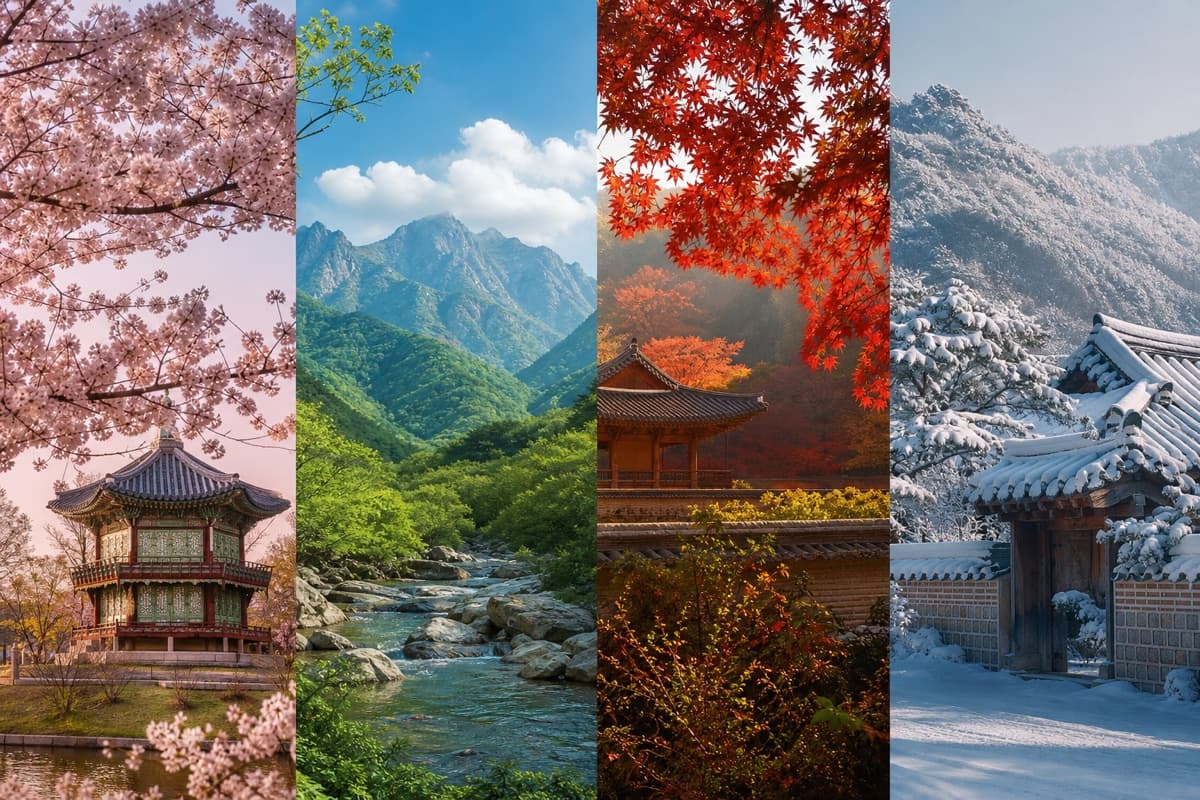
Four Seasons, Four Moods: How Seasons Shape Korean Life
Korea experiences four sharply distinct seasons, and each one transforms not just the landscape but the entire rhythm of daily life. The food changes, the activities shift, and even the national mood swings along with the temperature. For Koreans, seasons aren't just weather. They're cultural events with their own traditions, foods, and social expectations.
Spring (봄, Bom): Renewal and Pink Petals
Spring in Korea runs roughly from late March through May, and it arrives like a switch being flipped. After months of brutal cold, temperatures climb into the teens and twenties, and the entire country collectively exhales.
Cherry Blossoms (벚꽃, Beotkkot)
Nothing defines Korean spring like cherry blossom season. For about two weeks in early to mid-April, pink and white blossoms explode across the country, and Koreans respond with an almost religious devotion to flower viewing. Parks, riversides, and famous blossom spots fill with families, couples, and friend groups spreading picnic blankets and taking photos.
The cherry blossom front moves from south to north. Jeju Island blooms first in late March, followed by Busan and Gyeongju, and finally Seoul by mid-April. Korean weather services track and forecast the blossom front, and people plan trips around it.
Forsythia and Picnic Culture
While cherry blossoms get the international attention, many Koreans associate spring's arrival with 개나리 (gaenari, forsythia), the bright yellow flowers that line sidewalks and parks. Seeing forsythia means spring has started, regardless of the calendar.
Spring also triggers Korea's most enthusiastic picnic season. Han River parks in Seoul become a sea of blue tarps and delivery food on warm weekends. Ordering fried chicken delivery to your picnic spot by the river is a quintessentially Korean spring experience.
The Downside: Yellow Dust and Fine Dust
Spring isn't all blossoms and picnics. 황사 (hwangsa, yellow dust) blows in from Chinese and Mongolian deserts, and combined with 미세먼지 (misemeonji, fine particulate matter), spring air quality can be genuinely hazardous. Koreans check air quality apps as routinely as they check the weather, and masks were common on Korean streets long before the pandemic.
Summer (여름, Yeoreum): Heat, Rain, and Red Bean Ice
Korean summers are not for the faint-hearted. From June through August, the country swings between scorching heat and torrential rain, and both extremes shape how people eat, travel, and cope.
Monsoon Season (장마, Jangma)
장마 (jangma) typically hits in late June or early July and lasts three to four weeks. Heavy rains pound the peninsula almost daily, humidity climbs past 80%, and Koreans plan their lives around it.
The cultural response is distinctive: when it rains, Koreans crave 파전 (pajeon, scallion pancakes) and 막걸리 (makgeolli, rice wine). The sound of rain plus the sizzle of pancakes plus the sweetness of makgeolli is so ingrained that restaurants see pajeon orders spike whenever rain falls.
Beating the Heat
When jangma ends, raw heat takes over. August temperatures regularly exceed 35 degrees Celsius. Koreans have developed a whole vocabulary around summer survival:
- 피서 (piseo): Escaping the heat by traveling to the coast or mountains
- 빙수 (bingsu): Shaved ice dessert topped with red beans, fruit, or condensed milk. Premium versions at hotels and cafes cost $15-30
- 삼계탕 (samgyetang): Ginseng chicken soup, eaten on the hottest days
Samgyetang on Boknal
Eating hot soup on the hottest days seems counterintuitive, but 복날 (boknal) is deeply embedded in Korean culture. Three designated boknal days each summer (초복, 중복, 말복) send Koreans to samgyetang restaurants, where lines can exceed an hour. The logic follows traditional Korean medicine: fighting heat with heat to restore energy.
Fall (가을, Gaeul): Colors, Harvest, and Hiking
Ask any Korean their favorite season, and most will say fall. September through November brings comfortable temperatures, clear skies, and what might be Korea's most beautiful natural scenery.
Foliage Viewing (단풍놀이, Danpung Nori)
Just as cherry blossoms define spring, 단풍 (danpung, autumn foliage) defines fall. Korean mountains transform into gradients of red, orange, and gold. Seoraksan, Naejangsan, and Bukhansan national parks fill with hikers carrying thermoses and kimbap.
The foliage front moves opposite to cherry blossoms: north to south, starting in late September at Seoraksan and reaching the south by late October.
천고마비 (Cheongomabi): Sky High, Horse Fat
This classical Korean idiom literally means "the sky is high and horses get fat." It's the poetic way of describing fall's ideal conditions: clear, high skies and such abundant harvests that even horses fatten up. Koreans use this phrase to describe the perfect fall day, and it captures the season's spirit beautifully.
Chuseok (추석)
Korea's biggest holiday falls in autumn, usually in September or October by the solar calendar. Chuseok is the Korean harvest festival and Thanksgiving equivalent. Families gather, visit ancestral graves, and eat 송편 (songpyeon), half-moon-shaped rice cakes filled with sesame, beans, or chestnuts.
Modern Chuseok involves massive traffic jams as the entire urban population drives to their hometowns simultaneously. A three-hour journey can stretch to eight or more. Despite the traffic, Chuseok remains a time of genuine family connection.
Hiking and Harvest Season
Korea is about 70% mountains, and fall is peak hiking season. Weekend trails become congested enough to require wait times at popular peaks. Korean hiking culture has its own quirks: serious mountain fashion (North Face and Black Yak are status symbols), trailside makgeolli stops, and snacks that always include kimbap and hard-boiled eggs.
감 (gam, persimmon) season peaks in October and November. Sweet persimmons are eaten fresh, while astringent ones are dried into 곶감 (gotgam), a traditional delicacy. Driving through the countryside, you'll see persimmons hanging from trees and drying on racks outside farmhouses.
Winter (겨울, Gyeoul): Cold, Kimchi, and Street Snacks
Korean winters are serious. December through February brings temperatures that regularly drop to minus 10 or 15 degrees Celsius, with wind chill pushing it even lower. But far from hiding indoors, Koreans have built a winter culture that's warm, communal, and surprisingly active.
Kimchi-Making Season (김장, Gimjang)
김장 (gimjang) is the annual tradition of making large quantities of kimchi to last through winter. Historically, this was a community event where families and neighbors gathered to prepare hundreds of heads of cabbage, and while modern Koreans can buy kimchi at any supermarket, gimjang remains culturally important.
UNESCO recognized gimjang as an Intangible Cultural Heritage in 2013. Even apartment-dwelling city families often participate, whether making a small batch at home or joining organized events. The sight of red pepper paste-covered cabbage being packed into containers is a winter ritual that connects generations.
Street Food Season
Winter unlocks the best of Korean street food culture:
- 군고구마 (gun goguma): Roasted sweet potatoes from drum-shaped ovens on street corners. The smell alone stops you in your tracks on a cold day.
- 붕어빵 (bungeoppang): Fish-shaped pastries filled with sweet red bean paste or custard. Despite the fish shape, no fish involved.
- 호떡 (hotteok): Sweet pancakes filled with brown sugar, cinnamon, and crushed peanuts. Biting into a fresh one and burning your tongue on molten sugar is a shared Korean winter experience.
- 어묵 (eomuk): Fish cake skewers served with hot broth. The broth is free, and warming your hands on a cup at a street cart is one of winter's small pleasures.
Staying Warm: Ondol, Hotpacks, and Padded Coats
Korean apartments feature 온돌 (ondol), underfloor heating that keeps the floor warm. Winter evenings on a heated ondol floor with tangerines and a blanket is the Korean version of hygge.
Outside, 핫팩 (hatpaek, hand warmers) are essential. Koreans stuff them in pockets, shoes, and even stick adhesive versions to their clothing. The long padded coat (롱패딩) became a national uniform, with nearly everyone wearing knee-length puffer coats from November through February.
Ski Culture and Christmas
Korea has a compact ski industry in Gangwon Province, with resorts like Yongpyong and Alpensia drawing weekend crowds from Seoul. The 2018 Pyeongchang Olympics boosted winter sports, and the facilities remain popular.
Christmas in Korea is primarily a couples' holiday, not a family event. Couples exchange gifts, book fancy restaurants, and walk illuminated streets. Family gatherings happen at Lunar New Year (설날) instead. Year-end (연말) brings company dinners (회식) and year-end parties (송년회) that fill December calendars.
Why Seasons Matter So Much
Korea's extreme seasonal variation forces people to live in sync with nature in ways that milder climates don't require. Spring optimism, summer endurance, fall contentment, and winter togetherness form a cycle that gives Korean life a structure that feels both ancient and completely modern.
Understanding this seasonal rhythm explains everything from why Korean restaurants change their menus four times a year to why your Korean friends post cherry blossom selfies every April. The seasons aren't background scenery in Korea. They're the main character.