Korean Convenience Stores: A Cultural Experience
Walk into a convenience store in most countries and you'll find a predictable selection: chips, candy, soda, maybe a sad-looking sandwich wrapped in plastic. Walk into a Korean convenience store and you'll find a full hot food bar, a ramyeon cooking station with free hot water, an entire wall of ready-to-eat meals, K-Pop collaboration snacks, a working ATM, and a group of friends drinking soju on plastic chairs outside at 11 PM on a Tuesday.
Korean convenience stores, known as 편의점 (pyeonuijeom), aren't just places to grab a quick snack. They're restaurants, social spaces, mini-marts, and cultural touchstones all rolled into a space the size of a large living room. For visitors and residents alike, understanding convenience store culture is essential to understanding daily life in Korea.
The Big Three Chains
Three convenience store brands dominate the Korean market, and you'll encounter all of them within a five-minute walk in any urban area.
CU (formerly FamilyMart Korea) is the largest chain with over 17,000 locations, known for strong private-label food and frequent promotions. GS25 runs a close second with equally impressive numbers and a reputation for innovative food collaborations. 7-Eleven Korea holds third position, though the Korean version operates very differently from its US or Japanese counterparts, with almost entirely localized products.
There are other chains like Emart24, but the big three account for the vast majority of stores you'll see.
What Makes Korean Convenience Stores Different
If you've only experienced convenience stores outside Korea, here's what will surprise you:
The Hot Food Bar
Most Korean convenience stores have a dedicated section with heated display cases offering items like:
- Fried chicken (including sweet garlic and spicy varieties)
- Corn dogs (cheese-filled, potato-coated, every variation imaginable)
- Tteokbokki (spicy rice cakes)
- Odeng/eomuk (fish cake skewers in warm broth)
- Steamed buns (filled with red bean, pizza, or custard)
The quality is surprisingly good. This isn't gas station food. Korean convenience store hot items are freshly prepared and rotated regularly.
The Ramyeon Station
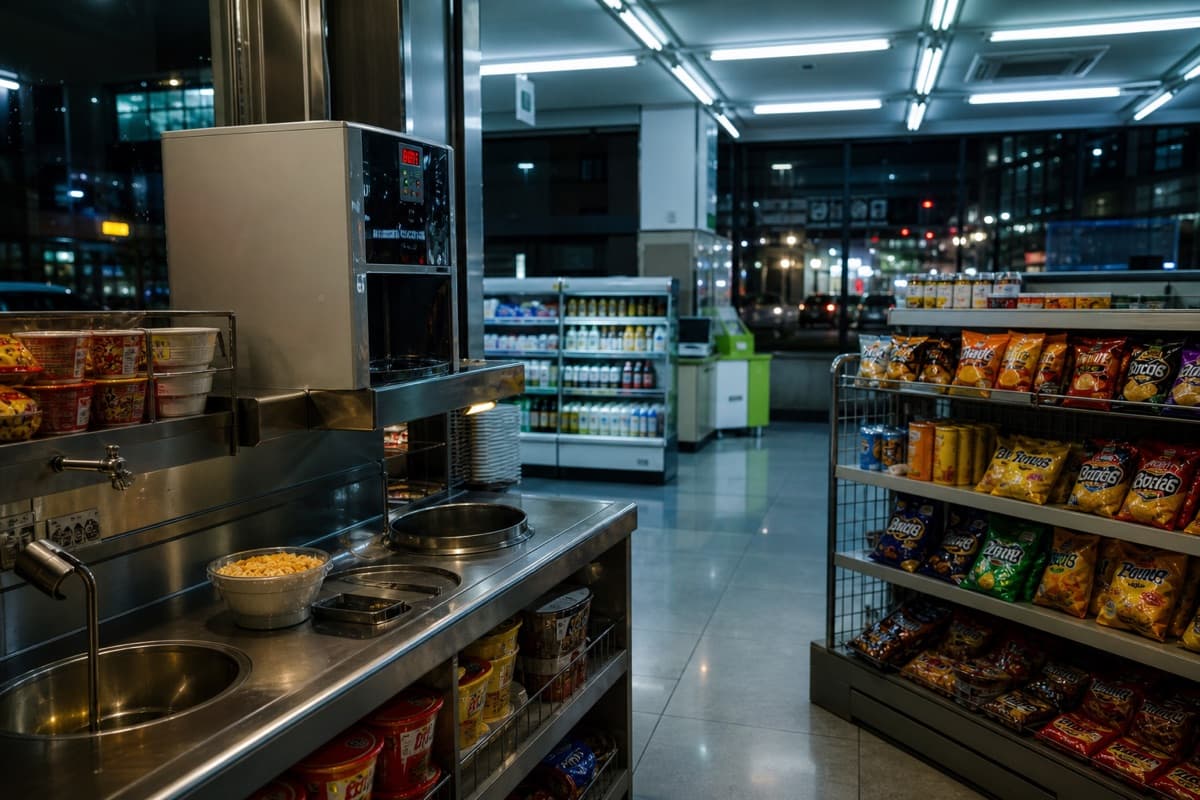
This is the feature that shocks most visitors. Many Korean convenience stores have a dedicated area with hot water dispensers, microwaves, and a small counter with chopsticks where you can buy instant ramyeon, cook it on the spot, and eat it right there.
Some stores have upgraded this setup with actual electric ramyeon cookers that boil water and cook your noodles properly. There's something genuinely satisfying about picking a ramyeon from the shelf, cooking it two meters away, and eating it while looking out the store window at a rainy Seoul street.
Ready-to-Eat Meals
The refrigerated section is where Korean convenience stores really shine. Options include:
- Dosirak (lunchbox-style meals) with rice, side dishes, and protein
- Gimbap (Korean rice rolls) in various flavors
- Sandwiches that are actually good (egg salad, strawberry cream, ham and cheese)
- Salads with Korean-style dressings
- Pasta dishes that you microwave in-store
These aren't afterthoughts. Major convenience store chains invest heavily in developing their meal lineups, often collaborating with celebrity chefs or popular restaurants to create exclusive items.
Must-Try Convenience Store Foods
If you're visiting Korea, these are the items you absolutely need to try:
Triangle Kimbap (삼각김밥)
The samgak gimbap is the icon of Korean convenience stores. It's a triangle of seasoned rice wrapped in seaweed with a filling in the center. Flavors include tuna mayo, kimchi, bulgogi, spam, and dozens more. They cost about 1,000-1,500 won ($0.75-$1.15), making them one of the best value meals anywhere.
The packaging has a specific opening technique (pull the top tab, then separate the sides) that every Korean person learns in childhood. Getting it right on your first try is a small but real accomplishment.
Cupbap (컵밥)
Single-serving rice bowls in a cup. Add hot water, wait a few minutes, and you've got a decent meal. Flavors range from curry to bibimbap to jjajangbap (black bean sauce rice).
Buldak Ramyeon (불닭볶음면)
Samyang's fire noodles have become globally famous thanks to social media challenges, but in Korea, convenience stores stock a dozen variations: original, cheese, carbonara, jjajang, and limited editions. They're legitimately spicy.
Banana Milk (바나나맛 우유)
Binggrae Banana Milk in its distinctive squat jar shape is probably the most beloved convenience store drink in Korea. It's been around since 1974, and Koreans of every age drink it. The flavor is sweet, creamy, and genuinely banana-forward. It's not health food, but it's a comfort drink with deep cultural roots.
Melona
This melon-flavored ice cream bar is a Korean summer staple. Creamy, refreshing, and available at every convenience store for around 1,000 won. They also come in strawberry, mango, and banana flavors, but the green melon original is the classic.
The 1+1 and 2+1 Culture
Korean convenience stores run promotions constantly, and the most common format is:
- 1+1 (원플러스원): Buy one, get one free
- 2+1 (투플러스원): Buy two, get one free
These deals are marked with prominent stickers on the products, and Koreans take them seriously. There are apps and online communities dedicated to tracking which stores have which deals at any given time. If you see a 1+1 sticker on something that looks interesting, take advantage of it.
Pro tip: The free item doesn't have to be the same product. In many stores, you can mix and match within the same promotion category. Two different flavors of the same drink, for example.
Convenience Store Drinking Culture
Here's where Korean convenience stores become truly unique social spaces. On warm evenings, you'll see groups of people sitting on plastic chairs and folding tables outside convenience stores, eating snacks and drinking.
This practice, sometimes called 편의점 술 (convenience store drinking), is a genuine cultural phenomenon. The appeal is straightforward: soju costs about 1,800 won ($1.40) at a convenience store versus 5,000-8,000 won at a restaurant. Beer is similarly cheap. Combined with affordable snacks, a convenience store becomes an extremely budget-friendly place to socialize.
Common pairings include:
- Soju + triangle kimbap (the classic budget combo)
- Beer + fried chicken from the hot food bar
- Soju + cup ramyeon (especially popular in winter)
- Makgeolli + snacks for a more traditional vibe
University students, office workers unwinding after late nights, and friends catching up all participate in this culture. It's casual, affordable, and surprisingly comfortable once you get used to the plastic furniture.
K-Pop Collaborations and Limited Editions
Korean convenience stores have figured out that K-Pop sells everything, and they lean into it hard. You'll regularly find:
- Idol-branded snacks and drinks (BTS coffee, BLACKPINK ice cream, NewJeans chips)
- Photocard promotions where buying specific products earns you random idol photocards
- Character merchandise from popular Korean IPs like Kakao Friends and LINE Friends
- K-Drama tie-in products timed to coincide with popular show premieres
These collaborations rotate frequently, and some become collector's items. Fans will visit multiple convenience stores hunting for specific photocards or limited-edition packaging.
Services Beyond Food
Korean convenience stores are remarkably full-featured:
- ATMs that work with international cards (GS25 and CU are generally the most reliable for foreign cards)
- Delivery pickup points for packages from Coupang, 11Street, and other e-commerce platforms
- Phone charging cables available for free use (or cheap purchase)
- Printing and copying services at some locations
- Bill payment kiosks
- Umbrella rental during rainy season
- Public transit card charging
For tourists, the ATM and delivery pickup functions are especially useful. Many accommodation hosts suggest nearby convenience stores as package pickup points.
Convenience Stores in K-Dramas
If you watch Korean dramas, you've seen convenience stores. The ramyeon-eating scene (often romantic) is practically a trope. Heart-to-heart conversations over triangle kimbap and late-night visits after emotional moments are standard plot devices. This reflects reality more than product placement. Convenience stores are woven so deeply into daily life that they naturally appear in Korean storytelling.
Price Comparison: Surprisingly Affordable
For visitors from Western countries, Korean convenience store prices are refreshingly low:
| Item | Approximate Price | |------|------------------| | Triangle kimbap | 1,000-1,500 won ($0.75-$1.15) | | Cup ramyeon | 1,200-2,000 won ($0.90-$1.50) | | Banana milk | 1,500 won ($1.15) | | Dosirak meal | 3,500-5,500 won ($2.70-$4.20) | | Soju (bottle) | 1,800-2,200 won ($1.40-$1.70) | | Beer (500ml can) | 2,500-3,500 won ($1.90-$2.70) | | Americano coffee | 1,500-2,000 won ($1.15-$1.50) |
You can eat a full, satisfying meal at a Korean convenience store for under $4. That's hard to beat anywhere in the developed world.
More Than Just Stores
Korean convenience stores have evolved into something that doesn't have a direct equivalent in most countries. They're part restaurant, part bar, part community hub, and part utility center. The density is staggering: Seoul alone has roughly one convenience store for every 50 residents.
For visitors to Korea, convenience stores are often the first place they experience genuine Korean daily life. Not the tourist version, not the K-Drama version, but the actual, everyday, triangle-kimbap-at-midnight reality. And honestly, that's one of the best introductions to the country you could ask for.