Korea's Cafe Obsession: Why There's a Cafe on Every Corner
Walk down any commercial street in Seoul, and you'll pass a cafe roughly every thirty seconds. That's not an exaggeration. South Korea has over 100,000 cafes nationwide, placing it among the highest cafe densities per capita in the world. Some Seoul neighborhoods have more cafes than residential buildings.
This isn't just about caffeine. Korean cafe culture represents a unique intersection of social needs, urban living constraints, aesthetic obsession, and a genuinely different relationship with public space. Once you understand why Koreans spend so much time in cafes, you understand something fundamental about modern Korean life.
From Dabang to Double Shot: A Brief History
Korean cafe culture didn't begin with Starbucks. Its roots go back to the dabang (다방), or "tea room," which first appeared in Korea during the Japanese colonial period in the 1920s and 30s.
Dabangs were more than places to drink tea. They served as informal gathering spots for intellectuals, artists, and business people. In the decades after the Korean War, dabangs became ubiquitous. Every neighborhood had one. They were where deals were made, news was shared, and people went to escape cramped homes.
The classic dabang was dimly lit, often playing classical music or Korean trot songs, and served instant coffee mixed with powdered creamer and sugar. This style of coffee, called daseot bong (다섯 봉) or simply "dabang coffee," remains nostalgic for older Koreans. You can still find it in vending machines across the country.
The shift toward modern cafe culture began in the late 1990s. Starbucks opened its first Korean location in 1999, in the Ewha Womans University neighborhood. It arrived at the perfect cultural moment: Korea was recovering from the 1997 Asian financial crisis, young Koreans were embracing global trends, and there was growing demand for spaces that felt different from the old dabang model.
What followed was nothing short of a cafe explosion.
The Chain Cafe Landscape
Korea's cafe market is one of the most competitive in the world, and the chain segment alone is staggering.
Starbucks Korea holds a special position. South Korea is consistently one of Starbucks' top global markets by store count and revenue. As of 2025, there are over 1,900 Starbucks locations in the country. Korean Starbucks stores are often larger and more architecturally distinctive than their counterparts elsewhere, and the brand carries significant social cachet. The Korea-exclusive merchandise and seasonal drinks generate real excitement.
But Starbucks isn't the whole story. Korean domestic chains have grown massively:
- Mega Coffee (메가커피) — Built on the "large size, low price" model. A large Americano costs about 2,000 won (~$1.50), roughly a third of Starbucks prices. Mega Coffee has become the biggest cafe chain in Korea by store count, surpassing even Starbucks.
- Compose Coffee (컴포즈커피) — Another budget chain that competes directly with Mega Coffee. Known for its yellow branding and franchise-friendly model.
- Ediya Coffee (이디야커피) — Positions itself as affordable but slightly more premium than the budget chains. Its slogan "always beside you" reflects its strategy of being everywhere.
- A Twosome Place (투썸플레이스) — Premium positioning with a strong dessert menu. Owned by CJ Group, one of Korea's largest conglomerates.
- Paik's Coffee (빽다방) — Founded by celebrity restaurateur Baek Jong-won. Budget-friendly with a retro dabang-inspired brand identity.
The competition is fierce. New cafes open constantly, and closure rates are high. Operating a cafe in Korea is one of the most common small business ventures, and also one of the riskiest.
Theme Cafes: There's One for Everything
Korea has taken the concept of themed cafes further than perhaps any other country. Whatever your interest, there is almost certainly a cafe built around it.
Animal Cafes
Dog cafes, cat cafes, raccoon cafes, sheep cafes, meerkat cafes. Korea pioneered many of these concepts. Visitors pay an entrance fee (usually 8,000-15,000 won) that includes a drink, then spend time with the resident animals. Animal cafes are popular with young Koreans who live in apartments where pets aren't allowed or who simply want animal interaction without the commitment of ownership.
Study Cafes and Reading Rooms
Study cafes (스터디카페) are a uniquely Korean phenomenon. These aren't regular cafes where students happen to study. They're purpose-built facilities with individual cubicles, timed entry (charged by the hour or with day passes), unlimited coffee from self-service machines, and strict noise rules.
The related concept of 독서실 (dokseosil), or "reading rooms," has existed for decades. These are paid study spaces used heavily by students preparing for college entrance exams or professional certification tests. Study cafes represent a modernized version of the same idea, with better design and amenities.
Why do Koreans pay to study in a separate building? The answer connects directly to housing culture. Many Korean homes, especially the one-rooms and officetels where young people live, are too small and distracting for serious study. Parents and siblings create noise. The dedicated study environment, with its social pressure to stay focused (everyone around you is studying), proves more effective.
Dessert and Specialty Cafes
Korean dessert cafes are in a category of their own:
- Bingsu cafes specialize in Korean shaved ice, particularly during summer
- Croffle cafes serve croissant-waffle hybrids with various toppings
- Traditional tea cafes (전통찻집) in areas like Insadong serve Korean teas from persimmon to citron
- Bakery cafes blur the line between patisserie and coffee shop, often with stunning pastry displays
Each trend cycle brings new specialty cafes. One season it's soufle pancakes. The next it's hand-drip single-origin coffee. The Korean cafe market moves fast, and staying relevant requires constant reinvention.
The Americano Obsession
Korea's default coffee order is the Americano (아메리카노), and the devotion to it borders on cultural identity.
Ordering is simple. "아아" (a-a) means iced Americano. "뜨아" (tteu-a) means hot Americano. These abbreviations are so universally understood that baristas won't even blink. During summer, iced Americano dominates so thoroughly that ordering a hot drink can get you a surprised look.
Why Americano specifically? Several factors:
- Price — It's the cheapest option on most menus, making it accessible for daily consumption.
- Calories — Korean diet culture is calorie-conscious, and a black Americano has virtually zero calories.
- Speed — It's fast to prepare, fitting Korea's pali-pali (빨리빨리, "hurry hurry") culture.
- All-day drinking — Its relatively mild flavor compared to espresso makes it easy to sip over long periods.
Koreans consume an average of over 400 cups of coffee per person per year, placing the country among the top coffee-consuming nations. And a huge portion of that consumption happens in cafes, not at home.
Cafe as Third Space
The concept of the "third space" (not home, not work, but a separate social environment) is especially relevant in Korea because of how Korean homes and workplaces function.
Korean apartments are small. As discussed in our piece on apartment culture, many young Koreans live in one-rooms or officetels where the entire living space might be 20 square meters. Inviting friends over is awkward when your bed, desk, and kitchen are all in the same room. The cafe becomes the living room you don't have.
Korean work culture is intense. Long hours and hierarchical office environments mean that workplaces aren't always comfortable for casual socializing. Cafes provide a neutral, non-hierarchical space where friends, couples, and even work colleagues can meet on equal terms.
Social culture emphasizes gathering. Koreans socialize in groups frequently, and those groups need places to meet. Cafes accommodate this perfectly. Large tables, comfortable seating, and the expectation of long stays make cafes ideal for everything from friend groups catching up to blind dates to business meetings.
In Korea, suggesting "let's meet at a cafe" is the default social invitation. It carries no particular significance about the relationship. Coffee dates, study sessions, work meetings, family catch-ups: all happen at cafes.
Cafe Etiquette: The Unwritten Rules
Korean cafe culture has its own set of norms that visitors should know:
- No strict time limits. Unlike some countries where lingering is discouraged, Korean cafes generally accept customers staying for hours after purchasing a single drink. This is essential to the cafe-as-living-room culture.
- Outlet culture. Many cafes provide electrical outlets at every seat, acknowledging that customers will be charging phones, working on laptops, and settling in for extended periods. Some cafes are specifically designed with workers and students in mind, with desk-style seating and USB ports.
- Buzzer system. Most Korean cafes use vibrating pagers that alert you when your order is ready. You order at the counter, take a buzzer, find your seat, and wait for the buzz.
- Water is self-service. Almost every Korean cafe has a water station with cups. You don't need to ask or pay for water.
- Seasonal and limited offerings. Koreans love limited-edition seasonal drinks and foods. Cherry blossom lattes in spring, strawberry everything in winter, sweet potato drinks in fall. Missing a seasonal item before it sells out creates genuine disappointment.
Instagram and Cafe Design
Korean cafes have become architectural attractions in their own right. The "Instagram-worthy cafe" isn't just a marketing buzzword in Korea. It's a legitimate business model.
Some cafes invest more in interior design than in their coffee program. You'll find cafes designed to look like:
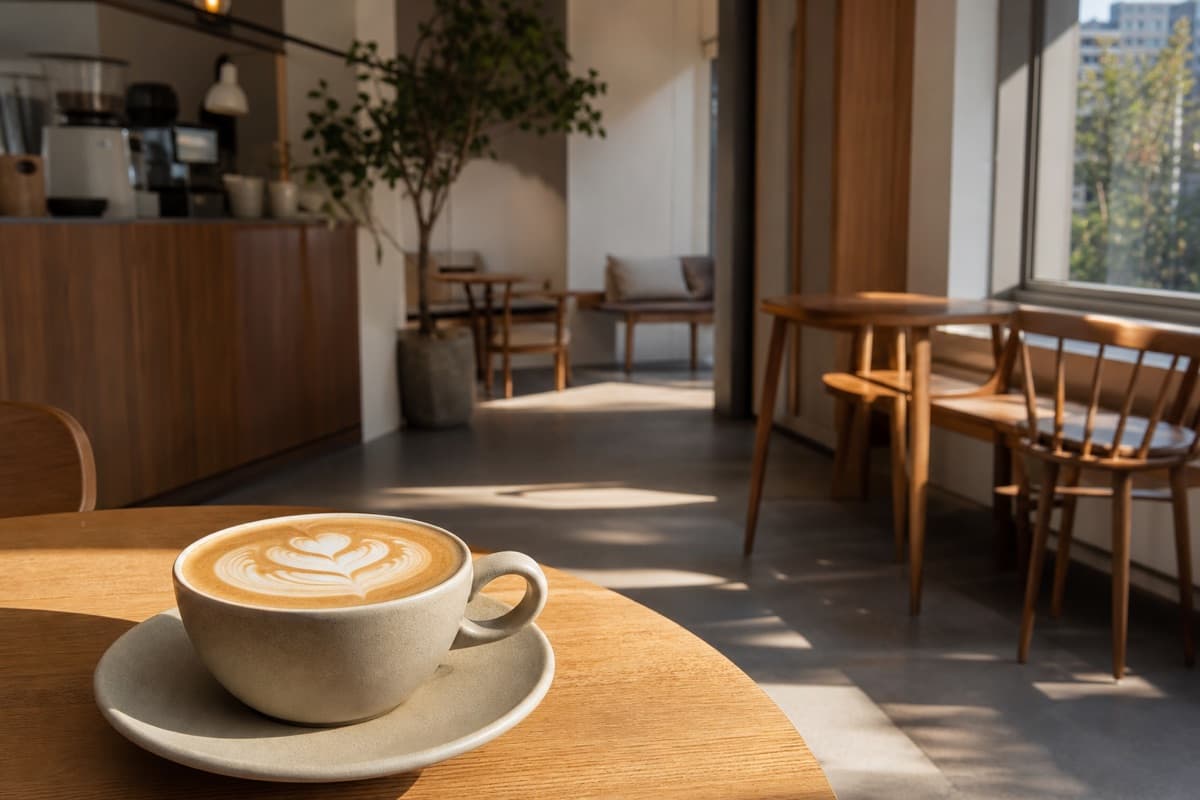
- Minimalist art galleries with nothing but white walls and a single plant
- Retro living rooms from the 1980s
- Industrial warehouses with exposed concrete and steel
- Greenhouse-style spaces filled with tropical plants
- Traditional hanok houses converted into modern coffee spaces
The photo-friendly design drives a specific behavior pattern: visit a new cafe, take photos, post them to Instagram or KakaoTalk, then move on to the next aesthetic experience. Many Koreans maintain running lists of cafes they want to visit, treating cafe-hopping as a leisure activity on par with shopping or watching movies.
Outside Seoul, destination cafes have become a category of their own. Massive cafes in coastal towns like Gangneung or resort areas like Jeju feature ocean-view terraces, sculptural architecture, and settings designed to justify the drive. These cafes can seat hundreds and regularly draw weekend crowds from distant cities.
Why the Obsession Won't Fade
Korea's cafe culture isn't a trend that will pass. It's structurally embedded in Korean life.
The small-apartment reality isn't changing. Work culture still demands long hours. The social need for comfortable gathering spaces remains strong. And the Korean capacity for turning any industry into a hyper-competitive, constantly innovating market ensures that cafes will keep evolving.
What started as a simple dabang serving instant coffee to tired workers has grown into one of the most dynamic cafe cultures on earth. Every block, every neighborhood, every city in Korea tells part of this story through the cafes on its corners. They're not just serving coffee. They're providing the space that modern Korean life requires but doesn't always supply at home or at work.
Next time you visit Korea, forget the guidebook attractions for an afternoon. Just pick a neighborhood, walk into the first interesting-looking cafe you see, order an iced Americano, and sit for a while. You'll be doing exactly what millions of Koreans do every single day.