Korean Weddings: Modern Ceremonies Meet Ancient Traditions
If you've ever attended a Korean wedding, your first reaction was probably surprise. The ceremony might have lasted barely 30 minutes. The venue might have been one floor of a multi-story wedding hall running several weddings simultaneously. And instead of a carefully wrapped gift, you probably handed over a white envelope of cash at a registration desk.
Korean weddings operate on a logic entirely their own. They blend modern Western-style ceremonies with ancient Korean traditions, practical financial systems, and a pace that can feel almost industrial to outsiders. But underneath the efficiency lies a culture that takes marriage, family obligation, and celebration seriously.
The Modern Ceremony: Quick, Bright, and Efficient
Most Korean weddings today follow a Western-style ceremony format, but with distinctly Korean characteristics.
Wedding Halls vs. Hotels vs. Outdoor Venues
The most common venue is a wedding hall (웨딩홀), a dedicated commercial facility designed specifically for weddings. Large wedding halls can host multiple ceremonies per day, often in different rooms on different floors. Thirty-minute time slots are standard, and the scheduling can feel surprisingly tight.
Hotel weddings carry more prestige and typically cost significantly more. Hotels offer bigger ballrooms, better food, and a sense of luxury. For families who want to signal status, a hotel wedding at places like the Shilla or Lotte Hotel in Seoul is the preferred choice.
Outdoor and garden weddings have surged in popularity among younger couples. Influenced partly by Western wedding culture seen in media, more Koreans are choosing estate venues, botanical gardens, or even beach locations. These weddings tend to be smaller and more personalized, which represents a real departure from tradition.
The 30-Minute Ceremony
A typical Korean wedding ceremony lasts between 20 and 40 minutes. The format usually includes:
- Entrance of the mothers, who light candles at the altar
- The groom enters and waits
- The bride walks down the aisle (usually with her father)
- A short officiant speech or blessing
- Exchange of vows and rings
- A congratulatory song performed by a friend or professional singer
- Bowing to the parents
- The couple exits
There is no lengthy sermon, no multiple readings, and rarely any personalized vows. The congratulatory song, called chukga (축가), is actually one of the most anticipated moments. Having a talented friend sing at your wedding is a point of pride.
Guest Expectations
Korean weddings are often large. Guest counts of 300 to 500 people are normal, and some exceed that. Many guests are parents' friends, business associates, and extended family that the couple may barely know. The wedding is as much a social event for the parents as it is for the couple.
Guests are not expected to stay for the entire event. Many arrive, register their cash gift, attend part of the ceremony, eat at the buffet, and leave. It's perfectly acceptable and even expected. The revolving-door nature of attendance is one reason the ceremonies stay short.
Pyebaek: The Traditional Ceremony Within
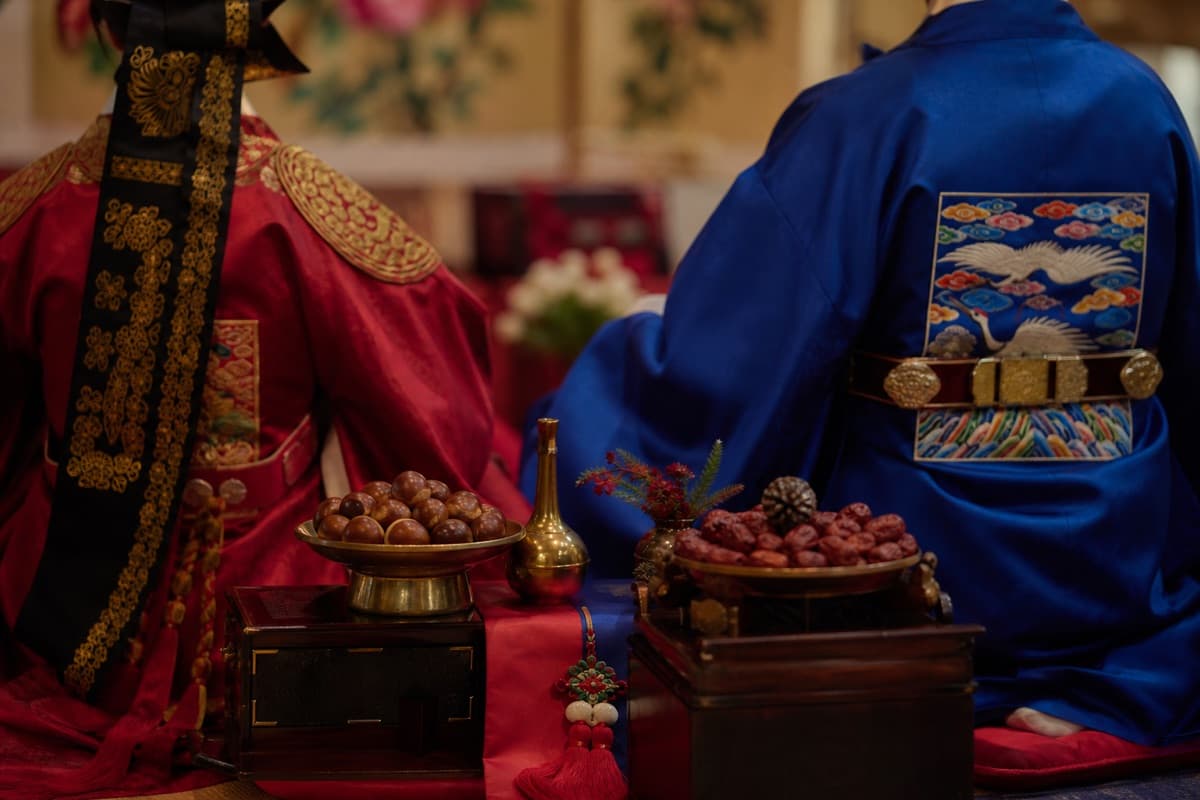
After the modern ceremony, most Korean weddings include pyebaek (폐백), a traditional Korean wedding ritual that takes place in a separate room. This is where ancient customs come alive.
During pyebaek, the bride and groom wear hanbok (한복), traditional Korean clothing. They perform deep bows (큰절, keun-jeol) to both sets of parents and receive blessings in return. The parents sit behind a table laden with traditional foods including:
- Dates (대추, daechu) and chestnuts (밤, bam), symbolizing children and fertility
- Dried beef jerky (육포, yukpo)
- Traditional rice cakes (떡, tteok)
In a playful tradition, the parents toss dates and chestnuts into the bride's skirt (held out like a pouch), and the number she catches is said to predict how many children the couple will have. The mood during pyebaek is usually warm and emotional, often more personal than the main ceremony.
The Cash Gift System: Chugeum
Perhaps nothing surprises foreign guests more than the Korean wedding gift system. Instead of buying items from a registry, guests give cash in a white envelope called chugeum (축의금).
How Much to Give
The amount follows social formulas based on your relationship to the couple:
- Casual acquaintance or coworker: 30,000 to 50,000 won (~$22-37 USD)
- Friend or closer colleague: 50,000 to 100,000 won (~$37-75 USD)
- Close friend or family member: 100,000 to 300,000 won (~$75-225 USD)
- Very close relationship or if you're older/senior: 300,000 won and up
There's a strong rule: avoid amounts with the number 4, as it's associated with death in Korean culture. Amounts should be in odd numbers (30,000, 50,000) or round even numbers (100,000).
The Registration Desk
When guests arrive, they go to a reception desk where they write their name and the amount in a ledger, then hand over the envelope. This is carefully tracked because families maintain a mental (and often literal) ledger of who gave what. When those guests have their own family events, you're expected to give back a similar or greater amount. It's a long-term social accounting system.
Wedding Food: The Buffet System
Gone are the days when Korean weddings served elaborate sit-down meals at every table. Today, most wedding halls operate a buffet system. After the ceremony (or sometimes during it), guests head to a large dining hall and serve themselves from a spread of Korean and Western dishes.
Food quality varies by venue and price point. High-end hotel weddings serve premium items like sashimi and galbi. More modest wedding halls offer standard Korean buffet fare. Either way, guests absolutely judge venues by their buffet quality.
A separate noodle station serving janchi-guksu (잔치국수), or banquet noodles, is a traditional wedding food staple. The long noodles symbolize longevity and a long, happy marriage. Asking someone "When are you going to feed me noodles?" is a playful Korean way of asking when they plan to get married.
Pre-Wedding Photoshoots
Korean couples take wedding photography very seriously. Pre-wedding photoshoots are a standard part of the process, typically done weeks or months before the actual wedding day.
Couples rent multiple outfits (wedding dress, hanbok, casual wear), spend an entire day at a professional studio or scenic outdoor location, and receive a thick album of retouched photos displayed at the wedding venue entrance. Studios offer comprehensive packages including hair, makeup, dress rentals, and dozens of edited photos. Spending $1,000 to $3,000 on the photoshoot alone is standard.
Who Pays for What?
Korean wedding costs are traditionally split between both families, but the specifics can vary and sometimes become a source of tension.
The general traditional expectation:
- The groom's family provides the housing (jeonse deposit or apartment purchase)
- The bride's family handles the wedding ceremony costs and furnishes the home (appliances, furniture)
In practice, this division has become increasingly flexible as housing costs have skyrocketed. Many modern couples negotiate their own arrangements. The financial discussion between families, called sanggyeon-rye (상견례), can be one of the most stressful parts of the engagement.
Matchmaking and Parents' Influence
While love marriages are the norm today, parents still play a significant role in Korean marriages. Formal introductions through family networks or professional matchmaking services (called seon, 선) remain common, especially for Koreans in their late 20s and 30s.
Parents also hold considerable influence over wedding decisions: venue, guest list, budget, and sometimes even the choice of partner. The concept of "marrying families, not just individuals" is deeply felt, and background checks on a potential spouse's family are practiced more openly than in many other cultures.
Unique Aspects That Surprise Foreigners
Several elements of Korean weddings consistently catch international visitors off guard:
- The noise level. Guests chat, move around, and check their phones during the ceremony. It's not considered disrespectful; it's just the culture of large Korean gatherings.
- Dress code flexibility. While guests generally dress nicely, you'll see a wider range of formality than at Western weddings. Wearing white is not taboo for guests.
- The speed. From arrival to departure, many guests are in and out within 90 minutes.
- Flowers and photo lines. Guests typically take photos with the couple on stage immediately after the ceremony, sometimes forming long lines.
- Professional MCs. Many ceremonies are hosted by a hired MC or a well-spoken friend who keeps things moving briskly.
Honeymoon Culture
Domestic honeymoons to Jeju Island were once standard. Today, popular destinations include Southeast Asian beach resorts (Bali, Danang), European tours, Hawaii, and the Maldives. "Honeymoon packages" from Korean travel agencies offering all-inclusive itineraries remain extremely popular.
Changing Trends
Korean wedding culture is shifting in several notable directions:
Smaller, more intimate weddings are gaining ground. The "small wedding" (스몰웨딩) movement favors fewer guests, more personal ceremonies, and unique venues over massive wedding hall events.
Later marriages and declining marriage rates are reshaping the industry. Young Koreans cite financial pressure, housing costs, and career demands as reasons to delay or forgo marriage entirely.
Non-traditional formats are slowly emerging. Some couples opt for destination weddings abroad or simple courthouse registrations followed by a party. These remain the minority but represent a real cultural shift.
Despite all the changes, the core elements persist. The pyebaek bows, the white envelopes, the noodles, and the parents' tears remain constants at Korean weddings. What's evolving is everything around them, as a new generation figures out how to honor tradition while making the celebration their own.