Korean Holidays Explained: Chuseok, Seollal, and Beyond
If you follow Korean culture at all, you've probably noticed that the country seems to shut down at certain times of the year. K-pop comebacks get delayed, your favorite K-drama takes a week off, and your Korean friends suddenly disappear to visit their hometowns. These are Korea's major holidays, and they carry a weight that goes far beyond a simple day off work.
Korean holidays are a mix of centuries-old lunar calendar traditions and more modern national celebrations. Some will feel familiar if you're used to Western holidays. Others are entirely unique. Here's everything you need to know.
Seollal: Korean Lunar New Year
Seollal (설날) is the biggest holiday on the Korean calendar, celebrated on the 1st day of the lunar calendar (usually late January or February). It's a three-day public holiday, and for many Koreans, the entire week surrounding it becomes a blur of travel, family gatherings, and food.
The Great Migration
During Seollal, Korea experiences what's often called "민족 대이동" (minjok daeidong, the great national migration). Millions of people travel from Seoul and other major cities back to their hometowns. Highways that normally take three hours to drive can take eight or more. Train and bus tickets sell out weeks in advance. If you're in Korea during Seollal, expect Seoul to feel noticeably emptier while smaller cities and rural areas come alive.
Sebae: The New Year's Bow
The centerpiece of Seollal is sebae (세배), a deep bow performed by younger family members to their elders. Children and grandchildren kneel on the floor, place their hands together, and bow deeply while saying "새해 복 많이 받으세요" (saehae bok mani badeuseyo), which means "Please receive many blessings in the new year."
In return, elders give sebaetdon (세뱃돈), New Year's money, usually in clean, crisp bills tucked into envelopes. For Korean kids, Seollal is essentially payday. The amounts vary by age and the family's means, but it's common for children to accumulate a surprisingly substantial sum by the end of the day.
Korean parents have a long-standing tradition of "holding onto" their children's sebaetdon for safekeeping. Whether that money ever actually makes it into the child's savings account is a running joke in Korean families.
Tteokguk: The Age-Adding Soup
You haven't properly celebrated Seollal until you've eaten tteokguk (떡국), a clear soup with sliced rice cakes. Beyond being delicious, tteokguk carries symbolic meaning: eating it represents gaining one year of age. Koreans will joke "먹어야 나이 먹지" (meogeoya nai meokji) meaning "you have to eat it to age."
The white rice cakes symbolize purity and a fresh start. The oval coin-like shape of the sliced rice cakes represents wishes for prosperity. Some families add dumplings to make tteok-manduguk (떡만둣국), which is arguably even better.
Other Seollal Traditions
- Hanbok (한복): Many Koreans wear traditional clothing during Seollal, especially for the sebae ceremony. Even families who've modernized in most ways often keep hanbok specifically for this occasion.
- Yutnori (윷놀이): A traditional board game played with four wooden sticks tossed in the air. It's competitive, loud, and has been a Seollal staple for centuries.
- Ancestral Rites (차례, charye): Families prepare an elaborate table of food offerings for deceased ancestors. The arrangement follows strict rules about which items go where.
Chuseok: Korean Thanksgiving
Chuseok (추석) falls on the 15th day of the 8th lunar month, typically in September or October. Like Seollal, it's a three-day holiday centered on family, food, and honoring ancestors. If Seollal is about welcoming the new year, Chuseok is about gratitude for the autumn harvest.
Songpyeon: The Holiday Rice Cake
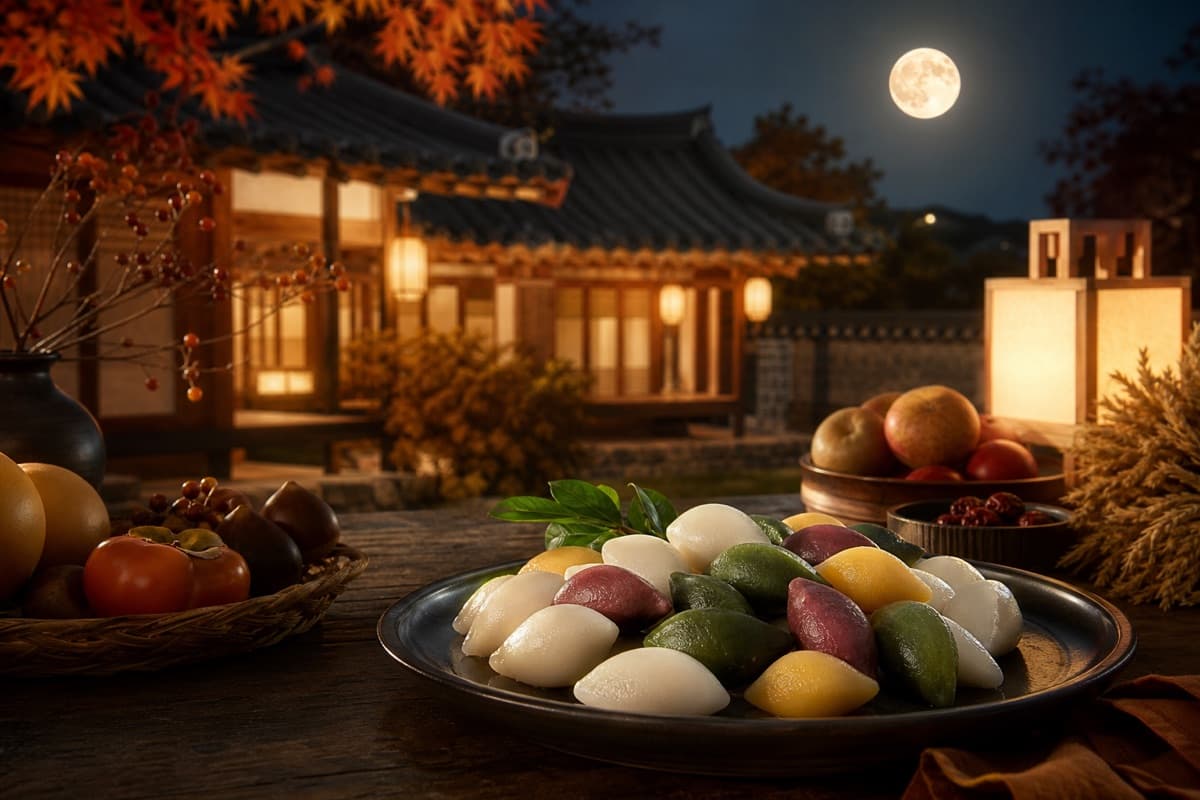
The signature food of Chuseok is songpyeon (송편), small crescent-shaped rice cakes filled with sesame seeds, red beans, chestnuts, or other sweet fillings. They're steamed on a bed of pine needles, which gives them a subtle fragrance.
Making songpyeon is a family activity, and there's a well-known saying: the person who makes the prettiest songpyeon will find a beautiful spouse (or have a beautiful baby, depending on who's telling you). This leads to some genuinely competitive rice cake shaping sessions at family gatherings.
Beolcho and Seongmyo
During Chuseok, families visit ancestral graves for beolcho (벌초, clearing weeds and tidying the gravesite) and seongmyo (성묘, paying respects). These visits happen before the holiday itself, and families often spend hours cleaning and maintaining the burial areas. For families with graves in rural or mountainous areas, this can involve hiking to remote locations.
The Chuseok Struggle Is Real
Modern Chuseok has a complicated reputation, especially among married women. Traditionally, the wife's family bears much of the cooking and preparation burden, which has led to ongoing cultural conversations about gender roles during holidays. Surveys consistently show that many Korean women feel stressed rather than relaxed during Chuseok, and there's been a gradual shift toward sharing responsibilities more equally or simplifying meals with store-bought options.
Korea's Unique Public Holidays
Beyond the two major holidays, Korea has several public holidays that reflect the nation's values and history.
Children's Day (어린이날, May 5th)
Children's Day is exactly what it sounds like, but Korea takes it seriously. Amusement parks are packed, toy stores run major sales, and parents plan elaborate outings. The holiday was established in 1923 by children's rights activist Bang Jeong-hwan, making it one of the oldest Children's Day celebrations in the world.
Parents' Day (어버이날, May 8th)
Rather than separate Mother's Day and Father's Day celebrations, Korea combines them into Parents' Day on May 8th. Children give carnations to their parents, and the day emphasizes filial piety (효도, hyodo), one of the core values in Korean culture. It's not a public holiday (you still go to work), but it's widely observed.
Hangul Day (한글날, October 9th)
Korea has a national holiday dedicated to its alphabet. Hangul Day celebrates the creation and proclamation of the Korean writing system by King Sejong the Great in 1446. Hangul was deliberately designed to be easy to learn, and Koreans are genuinely proud of having a scientifically constructed alphabet. The holiday was restored as a public holiday in 2013 after being downgraded in 1991, reflecting renewed national appreciation for the language.
Liberation Day (광복절, August 15th)
Gwangbokjeol commemorates Korea's liberation from Japanese colonial rule on August 15, 1945. The name literally means "the day the light returned." It's one of the most patriotic holidays, with ceremonies, flag displays, and occasional public events.
Memorial Day (현충일, June 6th)
Hyeonchung-il honors soldiers and civilians who died in service to the nation. At 10:00 AM, a siren sounds nationwide, and people pause for a moment of silence. It's a solemn day with ceremonies at the Seoul National Cemetery.
How Korean Holidays Differ from Western Equivalents
If you're coming from a Western background, a few key differences stand out.
The lunar calendar matters. Seollal and Chuseok follow the lunar calendar, so their dates shift every year on the Gregorian calendar. January 1st (New Year's Day) is technically a public holiday too, but it's a quiet affair. The real celebration waits for Seollal.
Christmas is different. December 25th is a public holiday in Korea, which surprises many people given that Korea isn't a majority-Christian country (about 27% of the population identifies as Christian). But Korean Christmas has evolved into something closer to a couple's holiday, similar to Valentine's Day. Couples go on dates, exchange gifts, and eat Christmas cake. Family gatherings and religious observance still happen for Christian families, but the cultural default is romantic rather than familial.
No Thanksgiving comparison works perfectly. People often equate Chuseok with Thanksgiving, and the harvest theme does overlap. But Chuseok involves ancestor worship, grave visits, and specific ritual foods that don't have Thanksgiving equivalents. The family dynamics and social obligations around Chuseok are also more structured.
Gift-Giving Culture During Holidays
Korean holiday gift-giving is practically an industry. In the weeks before Seollal and Chuseok, department stores and supermarkets create massive displays of gift sets (선물세트, seonmul seteu). These sets include:
- Spam gift sets: Yes, canned Spam. It's not a joke. Premium Spam gift boxes are a hugely popular and respected holiday gift in Korea. CJ CheilJedang and Dongwon sell millions of these sets every holiday season.
- Korean beef (한우, hanu) sets: Premium domestic beef in presentation boxes.
- Fruit sets: Individually wrapped apples, pears, and melons, often at prices that would make your jaw drop. A single Korean melon set can cost over $50.
- Health supplements: Red ginseng, vitamins, and traditional tonics, especially popular as gifts for parents and in-laws.
- Tuna sets: Like Spam, canned tuna gift sets are a Korean holiday classic.
The gift is typically given to parents, in-laws, bosses, and important social contacts. Choosing the right gift set for your in-laws is a source of genuine stress for many Koreans.
Holiday Food Beyond Tteokguk and Songpyeon
While tteokguk and songpyeon are the headline dishes, Korean holiday tables are far more elaborate. A full Seollal or Chuseok spread might include:
- Japchae (잡채): Glass noodles stir-fried with vegetables and beef. A staple at every festive table.
- Galbi-jjim (갈비찜): Braised short ribs in a sweet soy sauce. This dish takes hours to prepare and is often the centerpiece.
- Jeon (전): Pan-fried fritters made from zucchini, fish, meat, or kimchi. The endless frying of jeon is the part of holiday cooking that Korean home cooks dread most.
- Namul (나물): Seasoned vegetable side dishes, typically three to five varieties including spinach, bean sprouts, and fernbrake.
- Sikhye (식혜): A sweet rice punch served cold as a dessert drink. It's the traditional way to end a holiday meal.
Preparing all of this food is a multi-day affair, and it's one of the reasons holiday gatherings carry a complex emotional weight for the family members doing the cooking.
Modern vs. Traditional Celebrations
Korean holidays are evolving. Younger generations increasingly use the long holiday weekends for travel rather than staying home for traditional ceremonies. The term "해외 탈출" (haewoe talchul, overseas escape) describes the trend of booking international flights during Chuseok and Seollal to avoid the obligations of family gatherings.
Some families have simplified ancestral rites, reducing the elaborate food preparations. Others have moved away from the hometown visit entirely, meeting in a neutral location like a restaurant. But the core elements persist: the bowing, the food, the togetherness. Even the most modern Korean family will typically observe sebae during Seollal and make (or buy) songpyeon during Chuseok.
Experiencing Korean Holidays as a Foreigner
If you're visiting Korea during a major holiday, a few things to keep in mind. Many restaurants and shops close during Seollal and Chuseok, especially in smaller cities. Public transportation runs on reduced schedules. Major tourist attractions like palaces and folk villages often hold special holiday events and traditional performances, which are well worth attending. Some temples also offer holiday programs where visitors can participate in traditional activities.
On the flip side, Seoul during Chuseok or Seollal is unusually quiet and peaceful. If you don't mind some closures, it's actually a pleasant time to explore the city without the usual crowds.
The holidays remain the cultural heartbeat of Korea. They're when the values that define Korean society come into sharpest focus: respect for elders, family bonds, gratitude, and shared history. Whether you experience them as a visitor watching the mass migration unfold or as a guest at a Korean family's table, these holidays offer a window into what Korea values most.