How Korea Became the Esports Capital of the World
When people talk about esports, Korea always comes up. Not as one of many competitive gaming nations, but as the country that invented professional gaming as we know it. The infrastructure, the fan culture, the broadcast systems, the coaching pipelines. Almost every piece of the modern esports machine was prototyped in South Korea before the rest of the world caught on.
But how did a country smaller than Pennsylvania end up dominating competitive gaming for over two decades? The answer involves economic crisis, internet cafes, military-style training regimens, and a culture that decided video games could be taken just as seriously as baseball or soccer.
The PC Bang: Where It All Started
To understand Korean esports, you have to understand the PC bang (PC방). These are internet cafes, but calling them that undersells the experience. Walk into any Korean city and you'll find PC bangs on practically every block. They're open 24 hours, charge about 1,000-1,500 won per hour (roughly $1), and feature rows of high-end gaming PCs with massive monitors, ergonomic chairs, and blazing-fast internet.
PC bangs exploded in the late 1990s, partly because of the Asian financial crisis of 1997. The Korean government invested heavily in broadband infrastructure as an economic recovery strategy, and the country ended up with some of the fastest internet speeds in the world. Combined with the fact that personal computers were expensive for many households, PC bangs became the go-to spot for young Koreans to game, socialize, and compete.
PC bangs serve instant noodles, rice dishes, and snacks. Friends meet there after school or work. The social element is critical: Korean gaming culture was never a solitary bedroom hobby. It was public, competitive, and communal from the start. This social DNA made the leap to spectator esports feel natural.
The StarCraft Era (1998-2010)
StarCraft: Brood War wasn't just a popular game in Korea. It was a national phenomenon. When Blizzard released StarCraft in 1998, it coincided perfectly with the PC bang boom. The game was complex enough to reward skilled play, fast-paced enough to entertain viewers, and competitive enough to create genuine rivalries.
What happened next was unprecedented. The cable network OGN (OnGameNet) started broadcasting StarCraft matches on television in 2000. Imagine tuning into a dedicated TV channel to watch someone play a computer game. In 2000. The rest of the world was still figuring out dial-up internet, and Korea was already producing professional gaming broadcasts with commentators, instant replays, and studio audiences.
Pro Gamers as Celebrities
Players like Lim Yo-hwan (BoxeR) and Lee Yun-yeol (NaDa) became genuine celebrities. BoxeR had a fan club with tens of thousands of members. He appeared on variety shows, had corporate sponsorships, and was recognized on the street. These players were earning six-figure salaries from gaming at a time when the concept of a "professional gamer" didn't even exist in most countries.
Teams were sponsored by major Korean corporations. Samsung, SK Telecom, KT, and CJ all fielded StarCraft teams. The ProLeague, a team-based league, ran from 2003 to 2016 and drew huge viewership. OGN's individual StarCraft League (OSL) and MBC's equivalent (MSL) were the two most prestigious tournaments.
The infrastructure that developed around StarCraft set the template for everything that followed: team houses, professional coaches, salaried players, broadcast production, and organized fan events.
League of Legends: Global Domination
When League of Legends overtook StarCraft as Korea's dominant esport around 2012, the existing infrastructure simply shifted to the new game. And Korean teams didn't just compete at the international level. They dominated it.
The League of Legends World Championship (Worlds) has been held annually since 2011. Korean teams have won the title more than any other region. T1 (formerly SK Telecom T1) alone has claimed multiple world championships, building one of the most successful dynasty runs in any competitive sport.
Faker: The Greatest of All Time
No discussion of Korean esports is complete without Lee Sang-hyeok, better known as Faker. Widely regarded as the greatest League of Legends player in history, Faker has been with T1 since 2013. His longevity, mechanical skill, and ability to perform in high-pressure situations have made him a global icon.
Faker's face appears on billboards across Seoul. He's done campaigns for Nike, Mastercard, and Mercedes-Benz. His contract with T1 is reportedly worth millions of dollars annually. In many ways, Faker represents the full realization of what Korea's esports infrastructure set out to create: a professional athlete whose career is treated with the same seriousness as any traditional sport.
Other Korean teams like Gen.G, DRX, and Hanwha Life Esports consistently rank among the world's best, ensuring the region's reputation stays intact as other countries develop their own scenes.
Beyond League: Overwatch, Valorant, and More
Korea's competitive dominance extends beyond League of Legends. In the Overwatch League, Korean players and teams were so dominant in the early seasons that other regions struggled to compete. Many Western teams recruited Korean players specifically because of their superior mechanics and team coordination.
Valorant has seen Korean teams rise rapidly as well, with DRX winning the 2022 Valorant Champions tournament. Games like PUBG, FIFA Online, and various fighting games also have strong Korean competitive scenes.
The pattern is consistent: when a new competitive game gains traction, Korean organizations quickly build teams and develop players through established training pipelines.
The Training Machine
What makes Korean esports players so consistently good? A lot of it comes down to a training culture that would make Olympic coaches nod in approval.
Team houses (gaming houses) are where players live and practice together. A typical day for a professional Korean esports player looks something like this:
- 10:00 AM: Wake up
- 11:00 AM - 1:00 PM: Solo practice (individual mechanics)
- 1:00 PM - 2:00 PM: Lunch
- 2:00 PM - 7:00 PM: Team scrimmages (5+ hours of coordinated team play)
- 7:00 PM - 8:00 PM: Dinner
- 8:00 PM - 10:00 PM: VOD review and strategy sessions with coaches
- 10:00 PM - 1:00 AM: Additional solo practice
That's 10-14 hours of gaming per day, six or seven days a week. Teams employ not just head coaches, but also analysts who study opponent strategies, sports psychologists who help players manage stress, and physical trainers who address the health problems that come with extended sitting.
Esports Stadiums and Fan Culture
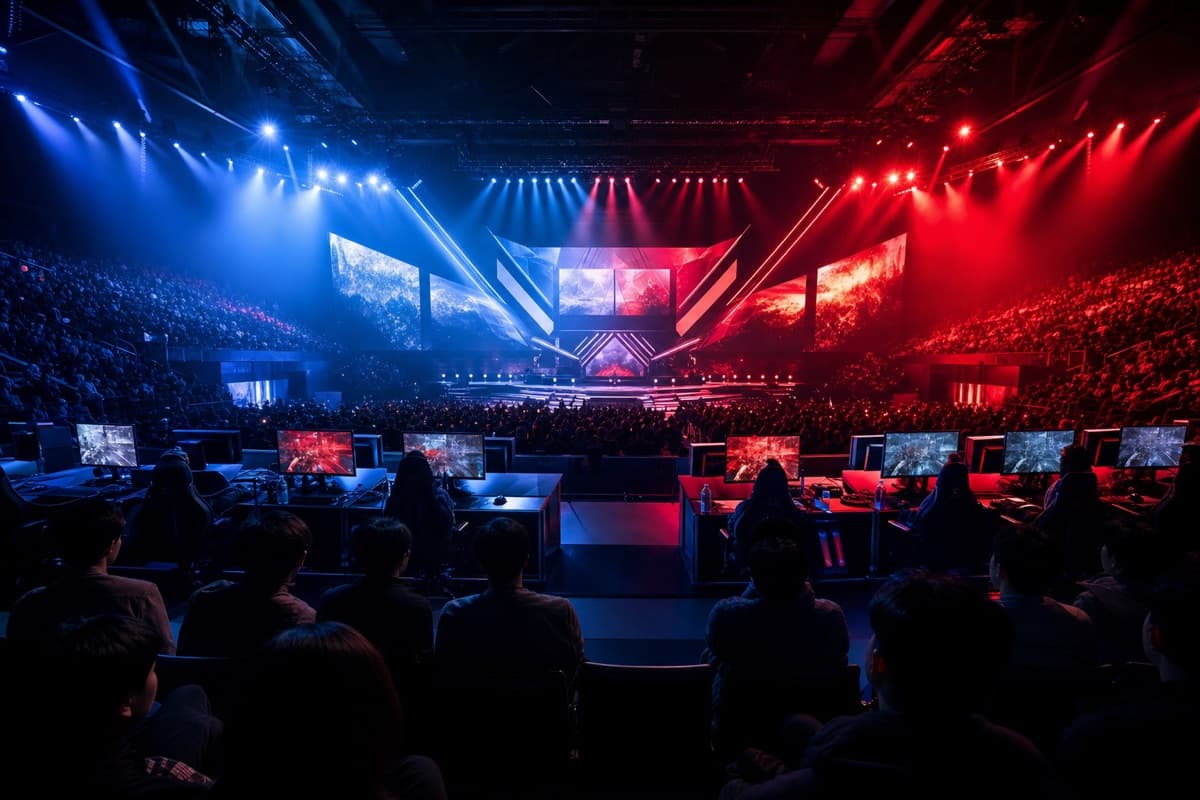
Korea has purpose-built esports venues. The LoL Park in Jongno, Seoul, serves as the home studio for the LCK (League of Legends Champions Korea). It's a proper arena with tiered seating, professional lighting, and broadcast facilities that rival any TV studio.
Fan culture at Korean esports events borrows heavily from K-Pop. Fans create organized cheering sections with synchronized chants and banners. When a popular team wins, the crowd reaction sounds like a concert. Fan clubs send food trucks to esports venues for players. They create elaborate fan art, run social media accounts dedicated to individual players, and organize group viewings at PC bangs during major international tournaments.
The atmosphere at a Korean LCK match is something you can't replicate anywhere else. It's sports, it's entertainment, it's community, all happening in a space built specifically for gaming.
Money and Recognition
Prize pools for major tournaments regularly reach millions of dollars. But for top Korean players, tournament winnings are often secondary to salaries and sponsorships. Top LCK players earn between $500,000 and several million dollars per year in base salary alone.
Korean corporations invest heavily in esports teams. The government has recognized esports as an official sport, and the Korean Esports Association (KeSPA) regulates competitive gaming at the national level.
Military Exemption: The Ultimate Prize
One of the most unique aspects of Korean esports involves military service. All Korean men must serve roughly 18 months in the military, and this obligation has historically disrupted the careers of pro gamers at their peak.
However, in 2018, the Korean government granted military service exemptions to gold medalists at the Asian Games, where esports was included as a demonstration event. When Korea won gold in League of Legends at the 2022 Asian Games in Hangzhou (where it became an official medal sport), players like Faker received exemption from mandatory service. This policy change signaled that the government views esports achievement on the same level as traditional athletic accomplishment.
Korea's Global Influence
Korean esports didn't just stay in Korea. It exported the entire framework. When Western esports organizations started building their own leagues in the 2010s, they borrowed the Korean model: franchised leagues, salaried players, team houses, coaching staffs, and broadcast production standards.
The LCK broadcast style influenced how Riot Games produces international events. Korean training methods spread as coaches moved to other regions. Even the concept of a "fan meet" at esports events has Korean roots.
Today, other countries like China, the United States, and various European nations have developed strong esports ecosystems. But they all stand on foundations that Korea built first. From a PC bang in Gangnam to sold-out stadiums hosting world championships, Korea's journey from gaming cafe culture to esports superpower remains one of the most remarkable stories in modern sports history.