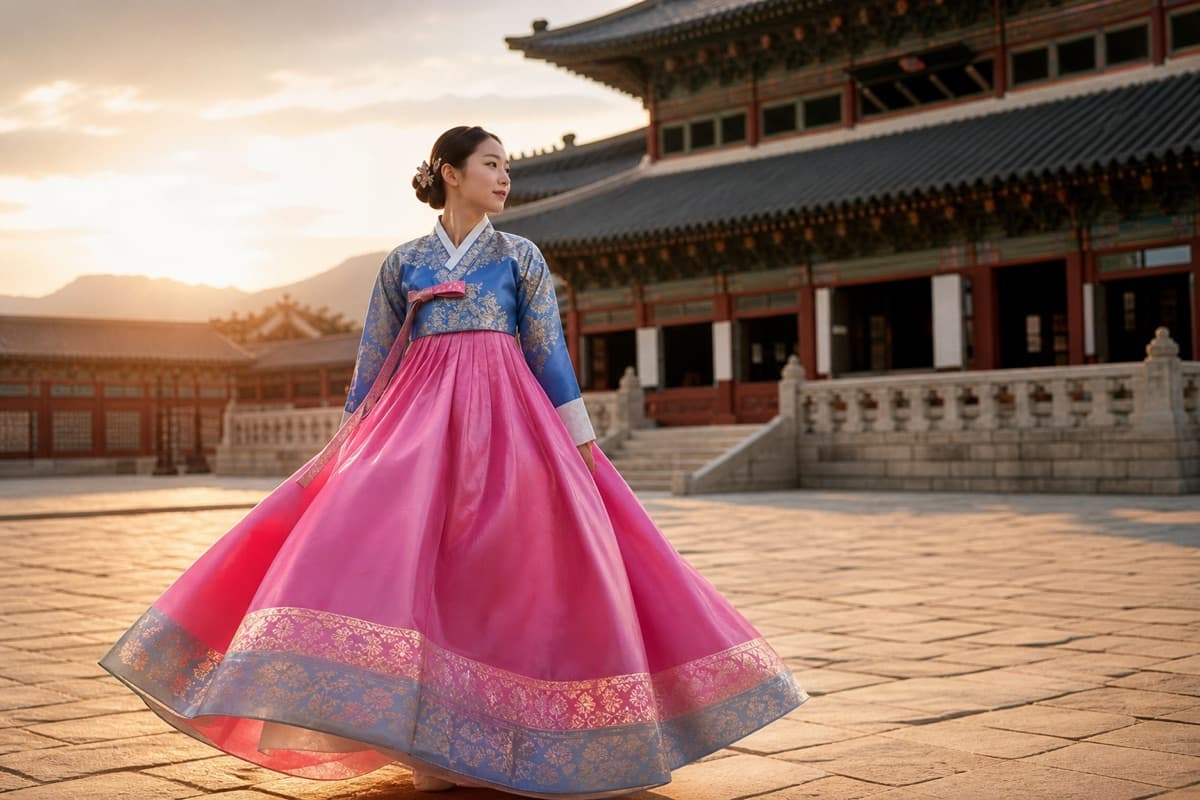
From Joseon to Runway: The Evolution of Hanbok
You've probably seen hanbok in a K-drama period piece or spotted tourists posing in colorful robes at Gyeongbokgung Palace. But hanbok is more than a costume or a photo opportunity. It's a living tradition that stretches back over a thousand years, carrying layers of social meaning, color symbolism, and aesthetic philosophy that still influence Korean fashion today.
Here's the story of how Korea's national dress evolved from royal court attire to a global fashion statement.
What Exactly Is Hanbok?
Hanbok (한복) literally means "Korean clothing." The term became necessary only after Western-style clothing arrived in the late 19th century, when Koreans needed a word to distinguish their traditional dress from the new imports.
At its core, hanbok is defined by a few key structural elements:
- Jeogori (저고리) — A short jacket worn by both men and women, tied at the chest with a long ribbon called the goreum (고름). The length and shape of the jeogori changed dramatically across different eras.
- Chima (치마) — A wraparound skirt worn by women, typically high-waisted and flowing to the floor. The fullness of the skirt creates hanbok's distinctive bell silhouette.
- Baji (바지) — Loose, wide-legged trousers worn by men. They were designed for sitting on heated floors (ondol), making cross-legged sitting comfortable.
- Durumagi (두루마기) — An overcoat worn over the jeogori and baji or chima for formal occasions or cold weather.
What makes hanbok unique is its emphasis on straight and curved lines working together. The rigid geometry of the jeogori contrasts with the flowing curves of the chima, creating a balance that Korean aesthetics prize. There are no tight fits or body-hugging cuts. The beauty comes from the garment's shape, not from revealing the body beneath it.
A Brief History: Three Kingdoms to Late Joseon
Three Kingdoms Period (57 BC – 668 AD)
The earliest versions of hanbok appeared during the Three Kingdoms era, when the Korean peninsula was divided among Goguryeo, Baekje, and Silla. Tomb murals from Goguryeo show men and women wearing jeogori jackets with baji or chima. These early garments were practical and relatively simple, with the jeogori extending to the waist or hip.
Both men and women wore similar silhouettes during this period, and the clothing reflected influences from Central Asian and Chinese nomadic cultures through trade routes.
Goryeo Dynasty (918 – 1392)
During the Goryeo period, hanbok began to develop more distinctly Korean characteristics. Mongol influence during the 13th century introduced shorter jeogori for women and higher-waisted chima. This is when the familiar proportions of women's hanbok started taking shape: a cropped jacket paired with a skirt that begins just below the chest.
Colors and fabrics became markers of social class. The upper classes wore silk in vibrant colors, while commoners were largely restricted to white or undyed fabric, earning Koreans the historical nickname "the white-clad people" (백의민족).
Joseon Dynasty (1392 – 1897)
Joseon is where hanbok reached its most refined and recognizable form. Neo-Confucian values shaped everything about clothing: modesty, hierarchy, and propriety. Every element of what you wore communicated your social position, marital status, age, and occasion.
Women's jeogori grew progressively shorter over the course of the dynasty. By the late Joseon period, the jeogori had shrunk so dramatically that it barely covered the chest, requiring a separate cloth band underneath. Meanwhile, the chima grew fuller and more voluminous.
Men's hanbok remained more consistent, with the scholar look of a jeogori, baji, and overcoat becoming the standard for educated gentlemen. Officials wore specific colors and patterns (like cranes or tigers embroidered on chest patches) to indicate their government rank.
The Meaning of Color: Obangsaek
Color in traditional hanbok is never random. The five directional colors, called obangsaek (오방색), form the foundation of Korean color symbolism:
- Blue/Green (청, cheong) — East, spring, wood. Represents growth and vitality.
- Red (적, jeok) — South, summer, fire. Symbolizes passion, good fortune, and protection from evil spirits.
- Yellow (황, hwang) — Center, late summer, earth. Associated with royalty and the universe's center.
- White (백, baek) — West, autumn, metal. Signifies purity, innocence, and modesty.
- Black (흑, heuk) — North, winter, water. Represents wisdom and infinity.
These colors weren't just decorative choices. A bride's hanbok traditionally featured red and green, combining fire and growth to symbolize a prosperous union. Children wore rainbow-striped sleeves (saekdong, 색동) because the combination of colors was believed to ward off evil spirits. Royal hanbok featured gold and deep red to assert authority and divine mandate.
The Korean saying "옷이 날개다" ("Clothes are wings") captures how deeply Koreans believe clothing transforms the wearer. In hanbok tradition, what you wore literally shaped your social reality.
When Do Koreans Wear Hanbok Today?
While hanbok disappeared from everyday wear during the 20th century, it never vanished entirely. Koreans still wear hanbok for several important occasions:
- Seollal (설날, Lunar New Year) and Chuseok (추석, Harvest Festival) — Families wear hanbok when performing ancestral rites and greeting elders. Children wearing hanbok and bowing to grandparents is one of the most iconic images of Korean holidays.
- Weddings — Traditional wedding ceremonies (pyebaek, 폐백) involve both the bride and groom wearing elaborate hanbok. Even in modern wedding halls, the pyebaek ceremony with hanbok remains standard.
- Doljanchi (돌잔치) — A baby's first birthday celebration. The child wears a specially made hanbok, often in bright colors with gold thread.
- Coming-of-age ceremonies — Though less common now, traditional coming-of-age rituals involve specific hanbok to mark the transition to adulthood.
For most Korean families, owning at least one set of hanbok for major holidays is still standard, even if it only comes out of the closet twice a year.
Hanbok Rental Culture in Seoul
One of the biggest drivers of hanbok's visibility in recent years is the rental industry around Seoul's historical palaces. Near Gyeongbokgung and Changdeokgung, dozens of hanbok rental shops offer tourists and Koreans alike the chance to dress up and explore the palace grounds.
Here's a detail many visitors don't know: wearing hanbok gets you free admission to Korea's major palaces. This policy, introduced by the Korean government, was designed to encourage engagement with traditional culture. The result is a constant stream of hanbok-clad visitors posing for photos against Joseon-era architecture.
The rental experience typically works like this:
- Choose your hanbok (options range from basic to premium, with prices from about 15,000 to 50,000 won)
- Get dressed with assistance from shop staff
- Have your hair styled and accessories added (hairpins, headbands, pouches)
- Explore the palace area for 2-4 hours
- Return and change back
The area around Bukchon Hanok Village has become particularly popular for hanbok photography, with the traditional hanok houses and narrow alleyways creating picture-perfect backdrops.
Modern Hanbok: Tradition Meets Street Style
A new movement has been reshaping hanbok for everyday life. Modern hanbok (생활한복, saenghwal hanbok, meaning "daily-life hanbok") takes the essential elements of traditional design and adapts them for practical wear.
What does modern hanbok look like in practice?
- Simplified jeogori paired with modern pants or skirts
- Hanbok-inspired dresses with the high waistline and flowing silhouette but made from everyday fabrics like cotton or linen
- Casual two-piece sets combining a short jacket with comfortable wide-leg trousers
- Fusion pieces that blend hanbok elements with Western tailoring
Brands like Leesle and Cheong-Wa Dae have built entire businesses around making hanbok that people actually want to wear on a Tuesday afternoon. These designers maintain the curved lines, ribbon ties, and flowing proportions of hanbok while using modern fabrics, simplified construction, and contemporary color palettes.
Hanbok on the Global Stage
Korean designers have been bringing hanbok to international fashion weeks, and the world has noticed. Designers like Kim Minjoo (known professionally as MÜNN) and Tchai Kim have shown collections that reinterpret hanbok's structure for global audiences. The curved lines, wrapped closures, and volume play of hanbok offer something genuinely different from Western fashion vocabulary.
Hanbok in K-Pop and K-Dramas
K-Pop has been a powerful vehicle for hanbok exposure. Groups like BTS, BLACKPINK, and Stray Kids have worn hanbok-inspired costumes in music videos and performances, introducing the aesthetic to millions of international fans. BTS's "IDOL" music video, featuring vibrant modern hanbok, became one of the most visible moments for hanbok in global pop culture.
K-dramas continue to be the most consistent showcase for traditional hanbok. Historical dramas (sageuk, 사극) like "Jewel in the Palace," "Moon Embracing the Sun," and "Mr. Sunshine" have all sparked spikes in hanbok interest. Costume designers for these shows research historical accuracy extensively, and viewers often become fascinated with the intricate details of court hanbok.
The influence flows both ways. International fashion houses have started incorporating hanbok-inspired elements into their collections, acknowledging the aesthetic power of Korean silhouettes. Wrapped closures, ribbon details, and voluminous skirts have appeared on runways from Milan to New York, often directly credited to hanbok's influence.
The Future of Hanbok
Hanbok sits at an interesting crossroads. On one side, traditionalists advocate for preserving the authentic forms, materials, and wearing methods of historical hanbok. On the other, designers and cultural entrepreneurs are pushing hanbok into entirely new territory.
The Korean government actively supports hanbok promotion through policies like the palace admission benefit, Hanbok Day (October 21st), and subsidies for hanbok-related businesses. Schools occasionally hold hanbok-wearing days, and some companies encourage employees to wear hanbok on cultural holidays. International interest has been growing steadily too, with hanbok rental shops reporting increasing numbers of foreign visitors who want to experience the clothing firsthand rather than just photograph it from the outside.
What seems clear is that hanbok's survival doesn't depend on freezing it in the past. Its long history is actually a story of constant adaptation. The hanbok of the Three Kingdoms looked nothing like the hanbok of late Joseon, which looked nothing like the modern hanbok you can buy from a Seoul boutique today.
That willingness to evolve while keeping the essential spirit might be hanbok's greatest strength. The curved lines, the flowing silhouettes, the meaningful use of color, and the emphasis on harmony over exposure remain consistent through every era. Whether it's worn by a Joseon scholar, a Seoul bride, a K-Pop idol, or a Paris runway model, hanbok carries something recognizably Korean that transcends any single moment in time.