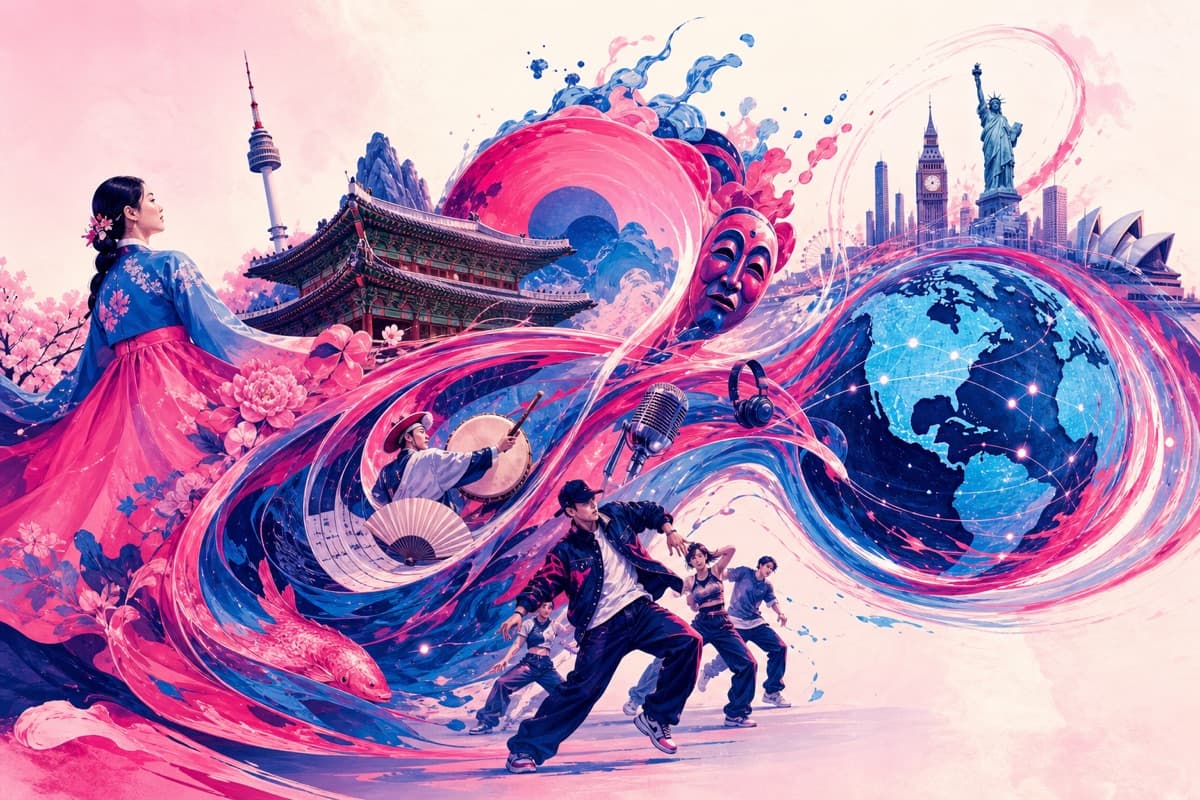
The Hallyu Wave: How Korean Culture Conquered the World
In 1999, a Chinese journalist in Beijing coined the term 한류 (hallyu), meaning "Korean Wave," to describe the sudden popularity of Korean entertainment in China. At the time, it referred mainly to a handful of K-Dramas and pop songs that had gained unexpected traction across East Asia.
Two decades later, hallyu has grown into one of the most powerful cultural export phenomena in modern history. Korean music tops global charts. Korean films win Oscars. Korean food has become a worldwide trend. Korean skincare routines are standard practice. The country of 52 million people punches so far above its weight in cultural influence that economists, diplomats, and cultural analysts all study it as a case study in soft power.
So how did this happen?
Hallyu 1.0: K-Dramas Capture Asia (1990s-2000s)
The first wave of hallyu was almost entirely driven by television dramas. In the late 1990s, Korean broadcasters started exporting their shows to other Asian markets, and the response was far stronger than anyone anticipated.
Winter Sonata: The Drama That Changed Everything
The most significant single event in early hallyu was Winter Sonata (겨울연가), a romantic drama that aired in Korea in 2002. When it broadcast in Japan in 2003 on NHK, it triggered a cultural phenomenon. Japanese viewers, especially women in their 40s and 50s, became obsessed with the show and its lead actor, Bae Yong-joon. He earned the nickname "Yon-sama" in Japan, and his visits to the country caused scenes that resembled Beatlemania.
Winter Sonata drove Japanese tourism to Korea. Filming locations became pilgrimage sites. Korean language enrollment in Japan surged. The show demonstrated that Korean cultural products could cross national and linguistic boundaries in ways that surprised even the Korean entertainment industry.
Spreading Across Asia
Following Winter Sonata, Korean dramas expanded into China, Southeast Asia, and even the Middle East. Dae Jang Geum (대장금, Jewel in the Palace), a 2003 historical drama about a female royal physician, was exported to over 90 countries and became a cultural touchstone in regions where Korean entertainment had zero prior presence.
Hallyu 2.0: K-Pop Goes Global (2010s)
The second wave shifted the center of gravity from dramas to music. K-Pop had been popular within Asia for years, but the 2010s saw it break into Western markets in a way that changed the global music industry.
PSY and the YouTube Revolution
In July 2012, PSY released "Gangnam Style." It became the first YouTube video to reach one billion views. The song charted worldwide, was parodied by everyone from politicians to morning show hosts, and proved that a Korean-language song could achieve mainstream global success.
While some dismissed it as a novelty hit, Gangnam Style's real impact was opening doors. It proved that language wasn't the barrier the Western music industry assumed it was, and it put K-Pop on the radar of international audiences who had never encountered it before.
BTS: Rewriting the Rules
If PSY opened the door, BTS (방탄소년단) kicked it off the hinges. Starting from a small entertainment company without the backing of the "Big 3" agencies, BTS built a global fanbase (ARMY) primarily through social media and authentic connection with their audience.
Their achievements are staggering:
- Multiple #1 albums on the Billboard 200
- Performances at the Grammy Awards
- Speaking at the United Nations General Assembly (multiple times)
- Stadium tours selling out in minutes across North America, Europe, and Asia
- Time magazine's list of the 100 most influential people
BTS proved that K-Pop success wasn't a fluke or limited to novelty acts. They demonstrated sustained, album-after-album, world-tour-level commercial viability for Korean-language music in Western markets.
BLACKPINK, EXO, TWICE, and the New Generation
BTS opened the floodgates. BLACKPINK became the highest-charting female Korean act on the Billboard Hot 100 and headlined Coachella. TWICE sold out stadiums across the US and Japan. Stray Kids, SEVENTEEN, aespa, NewJeans, and LE SSERAFIM continued pushing Korean music further into the global mainstream.
K-Pop became not just a genre, but an industry model that other countries started trying to replicate.
Hallyu 3.0: Full Cultural Export (2020s)
The third wave is characterized by Korean culture exporting not just entertainment, but a complete lifestyle package: film, food, beauty, fashion, language, and values.
Parasite: The Oscar Breakthrough
In February 2020, Bong Joon-ho's Parasite (기생충) won four Academy Awards, including Best Picture. It was the first non-English-language film to win that award in the Oscars' 92-year history. Bong's acceptance speech, delivered partly in Korean, included the now-famous line: "Once you overcome the one-inch-tall barrier of subtitles, you are introduced to so many more amazing films."
Parasite legitimized Korean cinema in the eyes of audiences who had previously ignored non-English films, and it amplified interest in the broader Korean film industry, from Park Chan-wook to Lee Chang-dong.
Squid Game: Streaming Changes the Game
In September 2021, Netflix released Squid Game (오징어 게임). It became the platform's most-watched series of all time, viewed in over 94 countries. The show's imagery, Korean children's games, and social commentary became global cultural reference points overnight.
Squid Game demonstrated something important: streaming platforms had eliminated the distribution barrier that previously limited Korean content to Asian markets. With Netflix, Disney+, and other platforms investing billions in Korean content, the geographical restrictions on hallyu effectively disappeared.
Beyond Entertainment
The 2020s hallyu extends well past screens:
- Korean food: Kimchi, bibimbap, tteokbokki, and Korean BBQ have gone from niche to mainstream in Western cities. Korean grocery products are increasingly common in international supermarkets.
- K-Beauty: The Korean skincare routine (double cleansing, essences, sheet masks) has influenced global beauty trends. Brands like Innisfree, Laneige, and COSRX are sold worldwide.
- Korean fashion: Seoul Fashion Week and Korean streetwear brands have gained international recognition.
- Korean language: Korean has become one of the fastest-growing languages for study globally, driven almost entirely by hallyu interest.
The Government's Role
Hallyu didn't happen entirely organically. The Korean government has actively supported cultural export as a strategic policy since the late 1990s.
Key institutions include KOCIS (Korean Culture and Information Service), Korean Cultural Centers in over 30 countries, and the Ministry of Culture, Sports and Tourism, which allocates significant budget to cultural industry development. Government-backed content funds invest directly in film, music, and game production.
The strategic insight was that cultural exports create economic value far beyond the content itself. A K-Drama viewer might visit Korea as a tourist, buy Korean products, study Korean, and become a long-term consumer of Korean cultural goods.
Economic Impact
The numbers behind hallyu are substantial:
- Korea's cultural content exports were valued at over $12.4 billion annually by the early 2020s
- Tourism: hallyu-related tourism contributes billions to the Korean economy. Fans visit filming locations, attend concerts, and explore the country they've come to know through media
- Consumer goods: Korean cosmetics, food, and fashion exports have all seen significant growth linked to hallyu interest
- Language education: Korean language programs have expanded in universities worldwide, creating a pipeline of people with cultural and economic connections to Korea
For a country with no oil, limited natural resources, and a relatively small population, cultural export has become one of Korea's most valuable economic engines.
Korean Language Learning Boom
One of hallyu's most measurable impacts is the surge in Korean language study. The number of people taking the TOPIK (Test of Proficiency in Korean) exam has increased dramatically over the past decade. Universities from Brazil to Egypt have added Korean language programs. Apps like Duolingo report Korean as one of their fastest-growing languages.
This matters because language is the deepest form of cultural engagement. A person who learns Korean to understand BTS lyrics or K-Drama dialogue without subtitles has made a commitment to Korean culture that goes far beyond casual fandom.
Anti-Hallyu Sentiment
Not everyone has embraced the Korean Wave. In China, political tensions (particularly the THAAD missile defense dispute in 2016) led to an unofficial ban on Korean entertainment content. In Japan, some groups have pushed back against perceived Korean cultural dominance. These backlashes tend to be driven by political friction rather than genuine cultural objection, but they've pushed the Korean industry to diversify its target markets.
The Future of Korean Soft Power
Hallyu shows no signs of slowing down. Streaming platforms keep investing in Korean original content. K-Pop's training system continues producing globally competitive acts. Korean gaming titles reach worldwide audiences. Korean tech companies are increasingly visible internationally.
The most remarkable thing about hallyu might be its self-reinforcing nature. A person who discovers Korean food might start watching K-Dramas, which leads to K-Pop, which leads to studying Korean, which leads to visiting Korea. Each successful export creates new fans who discover other aspects of the culture.
That chain of connection, from a single point of cultural contact to lasting engagement, is what makes the Korean Wave more than a trend. It's a fundamental shift in global cultural geography.