Korean Office Culture Decoded: What Blind App Reveals
If you want to understand what working in Korea is really like, don't read the corporate brochures. Read Blind.
Blind (블라인드) is an anonymous workplace community app where verified employees at Korean companies post about their jobs without fear of being identified. Think of it as a confession booth for office workers. On any given day, you'll find posts about salary comparisons, complaints about demanding bosses, debates about whether it's acceptable to leave work on time, and brutally honest reviews of company culture. The app has over 6 million verified users across Korea, and it has become one of the most revealing windows into Korean corporate life.
For foreigners curious about Korean workplace culture, or anyone considering a job in Korea, the conversations on Blind paint a picture that official sources never will. This post breaks down the key aspects of Korean office culture that Blind users discuss most, from mandatory company dinners to the quiet revolution of workers who just want to go home at 6 PM.
Hoesik: The Company Dinner You Can't Skip
Few topics generate as much debate on Blind as hoesik (회식, company dinner). Hoesik is a long-standing Korean tradition where a team or department goes out for dinner and drinks together, usually paid for by the company or the most senior person present.
On the surface, hoesik sounds great. Free food and drinks with your coworkers. In practice, it's more complicated.
Traditional hoesik follows a multi-round structure called cha (차, round). The first round, ilcha (1차), is typically a Korean BBQ dinner with soju. The second round, icha (2차), might be a bar or noraebang (노래방, karaoke room). Ambitious hoesik nights push into a samcha (3차, third round) at a late-night pojangmacha (포장마차, street food tent) or another bar.
The core tension: hoesik is technically voluntary but socially mandatory. Declining, especially as a junior employee, can be seen as a lack of team spirit. Blind is full of posts from workers asking, "Is it really okay to skip hoesik?" The answers vary wildly depending on the company, the team lead, and the industry.
On Blind, a common sentiment reads: "My team lead says hoesik is optional. But somehow, the people who skip it never get good project assignments."
The drinking component adds another layer of complexity. Superiors may pressure juniors to drink more, using phrases like hanjan deo (한잔 더, one more glass). While overt pressure has decreased compared to previous decades, it hasn't disappeared entirely. Younger workers on Blind frequently express frustration that their personal time is consumed by what feels like an extension of work, just with alcohol.
That said, attitudes are shifting. Many companies, particularly tech firms and startups, now hold hoesik during lunch hours, offer non-alcoholic options, or make attendance genuinely optional. Blind discussions show a clear generational divide: older workers tend to view hoesik as essential team bonding, while younger workers increasingly see it as an outdated obligation.
Hierarchy and Language: Speaking Your Way Through the Office
Korean workplaces are deeply hierarchical, and nowhere is this more visible than in language. Korean has built-in speech levels, and using the wrong one at work can cause real problems.
Jondaenmal (존댓말, formal/polite speech) is the default mode in any Korean office. You use it with superiors, senior colleagues, and anyone you don't know well. Banmal (반말, casual speech) is reserved for close friends of the same age or younger, and using it with a senior colleague would be a serious breach of workplace etiquette.
But it goes beyond just choosing verb endings. Korean office communication involves an entire system of titles and honorifics:
- Sajangnim (사장님): CEO/President
- Bujangnim (부장님): Department head/General Manager
- Gwajangnim (과장님): Section chief/Manager
- Daeri (대리): Assistant manager
- Sawon (사원): Staff/Entry-level employee
You address people by their title, not their name. Calling your bujangnim by their first name would be unthinkable in most Korean companies. Even in English-speaking environments within Korean firms, the Korean title system often persists.
Blind posts regularly surface from foreign employees or gyopo (교포, overseas Koreans) who struggle with this system. "I accidentally used banmal with my gwajangnim and the entire team went quiet" is a recurring type of post. The hierarchical language system extends to email, Kakao Talk messages, and even the order in which people enter an elevator. Seniors enter first.
The Slow Erosion of Formality
Tech companies and startups are leading a shift toward flatter communication styles. Some companies have adopted the nim (님) suffix for everyone regardless of rank, essentially a universal polite honorific without the rigid title hierarchy. Others use English names internally. Blind discussions about these "horizontal culture" (수평적 문화) companies are always popular, often generating hundreds of comments from workers at traditional firms expressing envy.
Kaltoegeun: The Revolution of Leaving on Time
One of the most emotionally charged topics on Blind is kaltoegeun (칼퇴근, leaving work exactly on time). The word literally combines kal (칼, knife) with toegeun (퇴근, leaving work), the image being a sharp, clean departure the moment the clock hits the end of your shift.
In many Korean workplaces, kaltoegeun was historically seen as a negative behavior. The unwritten rule was that you should stay until your boss leaves, or at least appear busy for a respectable period after official working hours. Leaving at 6 PM sharp might earn you disapproving looks or comments about your "lack of dedication."
This norm is connected to the broader concept of nunchi (눈치, social awareness/reading the room). Having good nunchi at work means sensing when your boss expects the team to stay late, even if no one explicitly says so. Workers with poor nunchi, those who pack up and leave on time without reading the atmosphere, risk being labeled as selfish or uncommitted.
But the tide is turning. South Korea implemented a 52-hour workweek law in 2018, reducing the previous 68-hour maximum. While enforcement has been uneven, the law gave workers legal backing to refuse excessive overtime. Blind became a space where workers share strategies for leaving on time:
- Setting up auto-responses after hours
- Physically packing bags a few minutes before the end of shift to signal departure
- Finding allies on the team who also want to leave on time, creating safety in numbers
Younger Korean workers, often called the MZ sedae (MZ세대, MZ generation, referring to Millennials and Gen Z), are increasingly vocal about their right to personal time. On Blind, posts celebrating successful kaltoegeun are met with supportive comments, while posts about managers who stay late to pressure the team draw outrage.
Salary Transparency and Job-Hopping
Blind's most practical value might be its salary-sharing culture. Korean workplaces traditionally kept compensation information private, and discussing your salary with coworkers was taboo. Blind changed that.
The app has dedicated boards where users share their exact compensation packages, broken down by base salary, bonuses, and benefits. Posts titled "Entering my 5th year at Samsung, here's my salary" or "Comparing Kakao vs. Naver total compensation" receive thousands of views and detailed replies.
This transparency has fueled a significant cultural shift: ijikhada (이직하다, changing jobs) is no longer the career-ending stigma it once was. In the past, Korean workers were expected to join a company after university and stay for decades. Loyalty was valued above almost everything else. Leaving a company, especially a prestigious one, raised questions about your character.
Today's Korean workers, armed with salary data from Blind, approach their careers more strategically. Key trends visible on the platform:
- Compensation benchmarking: Workers negotiate raises using real salary data from peers at competing companies
- Company culture reviews: Honest assessments of work-life balance, management quality, and growth opportunities
- Industry migration: Engineers moving from traditional conglomerates (재벌, jaebeol) to tech startups for better culture and equity compensation
- Return-offer culture: Workers who leave sometimes get re-hired at higher salaries, a practice that would have been unusual a generation ago
The most discussed employers on Blind Korea include the major tech companies (Naver, Kakao, Coupang, LINE), traditional conglomerates (Samsung, LG, SK, Hyundai), and increasingly, Korean branches of global firms (Google Korea, Apple Korea) where the culture gap with traditional Korean companies is a constant source of comparison.
Yageon Culture: The Overtime Problem
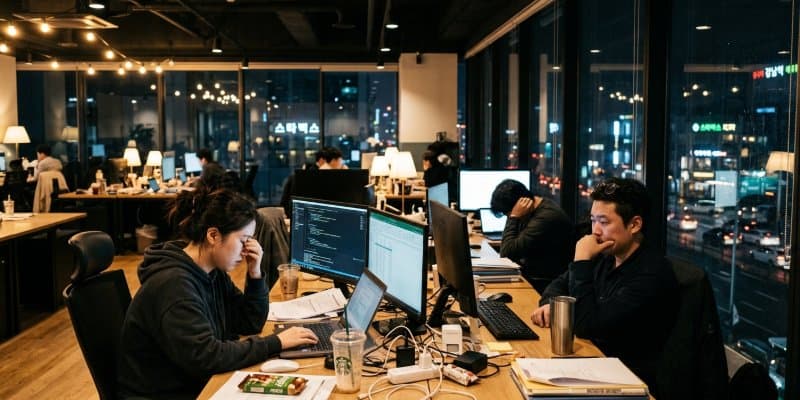
Despite the 52-hour law, yageon (야근, overtime/working late) remains one of the most discussed frustrations on Blind. Many Korean industries still operate on the assumption that long hours equal hard work, and the gap between legal working hours and actual working hours can be significant.
Common complaints on Blind include:
- Unpaid overtime: Some companies expect employees to clock out officially but continue working, a practice called seobiseu yageun (서비스 야근, unpaid "service" overtime)
- "Crunch" periods: Certain industries like gaming, advertising, and finance have notorious crunch seasons where 12-14 hour days are normalized
- Meeting overload: Back-to-back meetings during the day leave actual work for evening hours
- Senior presence pressure: Even without explicit demands, a bujangnim staying late creates implicit pressure for the entire team
The physical and mental health consequences are real. Korea has one of the longest average working hours among OECD countries, and burnout, or beonaut (번아웃), is a growing topic on Blind. Posts about seeking professional help for work-related stress and depression have become increasingly common and, notably, are met with supportive rather than dismissive responses from the community.
Some progressive companies have implemented measures like mandatory lights-off policies after a certain hour, PC shutdown systems that force computers off at the end of the workday, and explicit overtime approval requirements. These companies become recruitment magnets, and Blind discussions about their policies spread quickly.
How Korean Office Culture Differs from Western Workplaces
Foreigners working in Korean companies frequently post on Blind about the cultural adjustments they face. While every workplace is different, several patterns stand out in these cross-cultural discussions:
Communication style: Korean offices tend to favor indirect communication. A boss saying "this could be better" might mean "redo this completely." Reading between the lines is essential, and the nunchi concept applies here too. Western-style direct feedback can be perceived as confrontational.
Group orientation: Decisions often involve extensive consensus-building. Even if a manager has the authority to decide alone, they may circulate the idea through multiple layers first. This process, called pumui (품의, formal approval circulation), can feel slow to workers from cultures that value individual initiative.
After-hours expectations: Beyond hoesik, Korean work culture historically blurred the line between professional and personal time. Company Kakao Talk groups that stay active past midnight, weekend "voluntary" team activities, and holiday gift-giving expectations between colleagues all extend the workplace relationship beyond office hours.
Bonuses and recognition: Korean companies often distribute bonuses based on team performance rather than individual achievement. Seongwageup (성과급, performance-based pay) structures vary, but the team-first approach means individual standout performance isn't always rewarded the way it would be in Western firms.
Respect for seniority: Even if a junior employee has a clearly better idea, presenting it in a way that doesn't undermine their senior requires careful diplomacy. How you say something matters as much as what you say. Many Blind posts from younger workers describe the frustration of having good suggestions ignored because they came from someone too junior.
The Generational Shift
Perhaps the most fascinating aspect of Blind discussions is watching Korean workplace culture change in real time. The MZ generation is actively pushing back against norms that older generations accepted as immutable:
- Refusing unnecessary hoesik without guilt
- Using the 52-hour law to actually limit their working hours
- Sharing salary information openly
- Changing jobs without social stigma
- Demanding written overtime approval instead of accepting verbal pressure
- Choosing company culture over brand prestige when job-hunting
This doesn't mean old patterns have disappeared. Many traditional companies still operate under the old rules, and workers at these firms use Blind to vent, strategize, and sometimes find the courage to make a change. The gap between "new culture" companies and "old culture" companies is itself one of the platform's most discussed topics.
What Blind Tells Us About Korea
Blind is more than a workplace gossip app. It's an unfiltered record of a society in transition. Korean office culture is being renegotiated in real time, with workers using anonymity to say things they could never say in the hierarchical environments of their actual offices.
For foreigners looking to understand Korea beyond K-dramas and street food, the workplace is where so much of Korean social dynamics play out. The hierarchies, the group dynamics, the tension between tradition and modernization, the generational conflicts: they're all concentrated in the office.
Whether you're planning to work in Korea, doing business with Korean companies, or simply curious about how one of the world's most dynamic economies actually functions at the human level, Korean office culture is essential context. And Blind is where that context lives, unfiltered, unsigned, and unmistakably real.