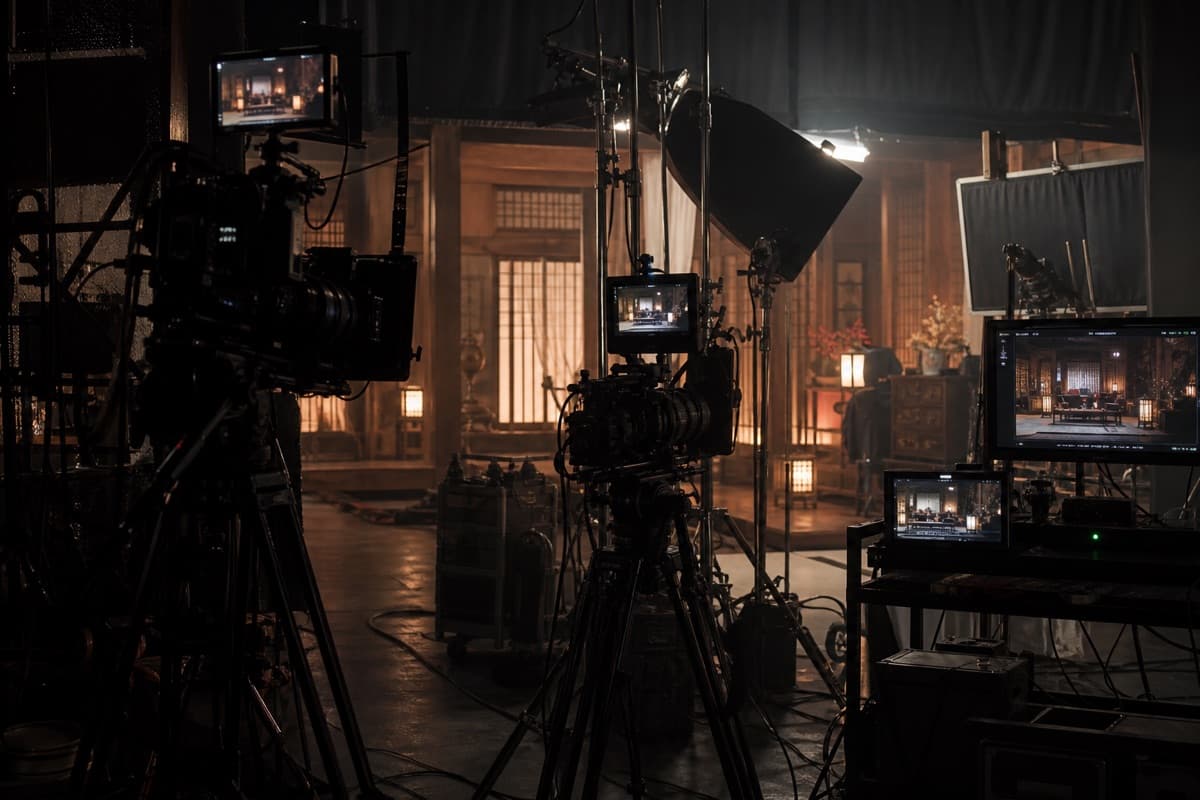
Behind the Scenes of K-Drama Production: Industry Secrets
K-dramas have conquered the world. What was once a niche interest for dedicated fans has become a global entertainment force, with shows like Squid Game, Crash Landing on You, and Extraordinary Attorney Woo drawing tens of millions of viewers across every continent. But the way these dramas are produced is radically different from how most international viewers imagine.
Behind every binge-worthy episode lies an industry with practices that would be unthinkable in Hollywood, creative pressures that shape every scene, and a recent transformation driven by streaming money that has rewritten the rules entirely.
The Live-Shoot System: Filming While Airing
The single most surprising fact about Korean drama production is this: for decades, episodes were often filmed while the show was already airing. This system, known as the "live-shoot" (생방송 체제), meant that actors and crew might finish filming an episode just hours before it was broadcast.
How It Worked
In a typical live-shoot production:
- A drama would begin filming 2-4 episodes before the premiere
- Once the show started airing (usually two episodes per week), production would race to stay ahead
- Scripts for upcoming episodes would arrive days, sometimes hours, before shooting
- Actors often received revised scripts on set, memorizing new dialogue between takes
- Post-production editing was compressed into impossibly tight windows
Why It Existed
The live-shoot system wasn't born from poor planning. It was a deliberate strategy. Korean broadcasters discovered that shows could achieve higher ratings when the production team could respond to audience feedback in real time. If viewers loved a secondary character, that character would get more screen time. If a plot point fell flat, the writers could adjust course within a week or two.
This created a feedback loop between audiences and creators that made Korean dramas uniquely responsive compared to Western shows, where entire seasons are typically completed before a single episode airs.
The Human Cost
The system was brutal for everyone involved.
Actors reported working 20+ hour days for months straight. Sleep deprivation was so severe that there are documented cases of actors collapsing on set. Learning lines was done in whatever stolen minutes were available between scenes.
Crew members worked under even worse conditions, with camera operators, lighting technicians, and editors often running on 2-3 hours of sleep during production periods.
Writers faced constant pressure to produce scripts on impossible timelines while incorporating network feedback, viewer sentiment data, and sponsor requirements.
One veteran drama director told Korean media: "We used to joke that we were making the airplane while it was already flying. But nobody was laughing."
The practice has decreased significantly thanks to stricter labor regulations, industry union advocacy, and the shift toward pre-produced streaming content. However, some network dramas still operate on compressed timelines.
How K-Dramas Are Funded
The business model behind K-drama production has undergone a seismic shift over the past decade.
The Traditional Broadcaster Model
Historically, Korean dramas were produced for the three major broadcast networks: KBS, MBC, and SBS. The funding structure worked like this:
- Network commissions: The broadcaster orders a drama from a production company
- Advertising revenue: Commercial breaks during the drama generate income
- Product placement (PPL): Brands pay to have their products featured in scenes
- International licensing: Broadcasting rights sold to other Asian markets
Under this model, budgets were relatively modest. A typical 16-episode drama might have a total budget of $5-10 million. Production companies operated on thin margins.
The Streaming Revolution
Then Netflix, Disney+, Apple TV+, and other global platforms arrived in the Korean market, and everything changed.
Netflix reportedly spent over $2.5 billion on Korean content between 2015 and 2024. This influx tripled or quadrupled per-episode budgets for premium shows, enabled full pre-production, gave creators more artistic freedom (free from episode-by-episode ratings pressure), and opened global distribution from day one.
Cable networks like tvN positioned themselves between broadcasters and streamers, producing shows like Signal and Reply 1988 that elevated production quality across the industry.
Product Placement: The Art of the K-Drama PPL
If you've watched more than a few K-dramas, you've noticed it: characters conspicuously eating at Subway, drinking coffee with the logo perfectly facing the camera, or using phones with brand names clearly visible. PPL (product placement) in K-dramas is not subtle, and that's partly by design.
Korean drama budgets have historically been tight, making PPL revenue essential. Sponsors demand visible placement, live-shoot production left no time for elegant integration, and Korean regulations require PPL to be identifiable. The result is product placement that's often hilariously overt.
K-drama fans have developed a love-hate relationship with PPL. Subway sandwiches appear so frequently it became a running joke. Characters deliver dialogue that sounds like advertising copy for coffee brands. Skincare products get held up to the camera for uncomfortable durations. And chicken-and-beer (치맥) scenes function as miniature commercials for specific fried chicken chains.
Filming Locations That Become Tourist Destinations
When a drama becomes a hit, filming locations experience a surge in visitors. Nami Island's visitor numbers exploded after Winter Sonata (2002). Bukchon Hanok Village became an Instagram destination through repeated K-drama appearances. Local governments actively court drama productions with tax incentives and infrastructure support, knowing the tourism revenue that follows. Some rural communities have been economically transformed by a single hit drama.
The Power of the Writer (작가)
In Hollywood, the director is typically the dominant creative voice. In Korean drama, that role belongs to the writer (작가, jakka).
Writer as Auteur
Korean drama writers are celebrities in their own right. Names like Kim Eun-sook (Goblin, Descendants of the Sun), Park Ji-eun (Crash Landing on You, My Love from the Star), and the Hong sisters (Hotel Del Luna) are brand names that guarantee viewer interest regardless of casting or directing.
The writer controls story, dialogue, character arcs, pacing, and thematic direction. Directors function more as visual interpreters of the writer's vision. This is a fundamental structural difference from Western television, where directors typically hold more creative authority. Top writers are extraordinarily well-compensated, but burnout is a serious issue given the volume and time pressure involved.
The OST: More Than Background Music
Original soundtracks (OST) play an outsized role in K-drama culture. Unlike Western shows where music is often atmospheric, K-drama OSTs are standalone pop songs performed by well-known artists that become hits in their own right.
OSTs are released as singles during broadcast, building simultaneous music and drama fanbases. Key emotional scenes become permanently associated with their songs, and OST releases serve as marketing events between episodes. The Goblin OST generated tens of millions of streams independently of the drama. For many overseas fans, K-drama OSTs are a gateway into Korean music beyond K-Pop.
The Actor Casting Process
Casting for K-dramas follows patterns that differ from Western television.
The Star System
Lead casting often happens before a script is finalized. A production company or broadcaster will secure a top-name actor, then build the project around their availability. This is partly because star power directly correlates with advertising rates and international sales potential.
For supporting roles, the process is intensely competitive. Korea has a large pool of trained actors competing for limited spots, with web dramas and cable productions serving as stepping stones. Meanwhile, actors with international "Hallyu star" status command significantly higher fees, creating a two-tier system.
How Streaming Changed Everything
The entry of global streaming platforms into the Korean market has been the most significant industry shift since the advent of color television.
Bigger Budgets, Higher Stakes
Netflix-funded K-dramas operate with per-episode budgets of $2-4 million, compared to $300,000-600,000 for traditional broadcast. This means better visual effects, international location shoots, completed scripts before filming begins, and higher production values across every department.
IP Ownership and Global Storytelling
A major tension has emerged around intellectual property. Netflix's model of buying global streaming rights means production companies surrender ongoing revenue. Korean producers are increasingly pushing back, seeking to retain ownership or negotiate better terms.
Streaming has also created a creative tension: should K-dramas adapt to global tastes or remain distinctly Korean? The evidence suggests the latter wins. Squid Game's commentary on Korean economic inequality, Extraordinary Attorney Woo's exploration of workplace culture, and Crash Landing on You's North-South Korean premise all drew global audiences precisely because they offered something viewers couldn't find elsewhere.
The Hallyu Tax Incentive
The Korean government has implemented tax incentives for content production as part of broader hallyu (Korean wave) support. These credits help keep Korean production competitive as global platforms seek content from multiple countries.
What Comes Next
The Korean drama industry is at an inflection point. Streaming money has raised production quality and global visibility, but it has also created new pressures: higher audience expectations, competition from other countries' content, and questions about sustainability.
What's unlikely to change is the fundamental appeal of K-dramas: tightly constructed stories, emotional depth, strong performances, and a cultural specificity that feels fresh to international audiences. The industry that perfected making dramas under impossible conditions is now learning how to make them under merely difficult ones.